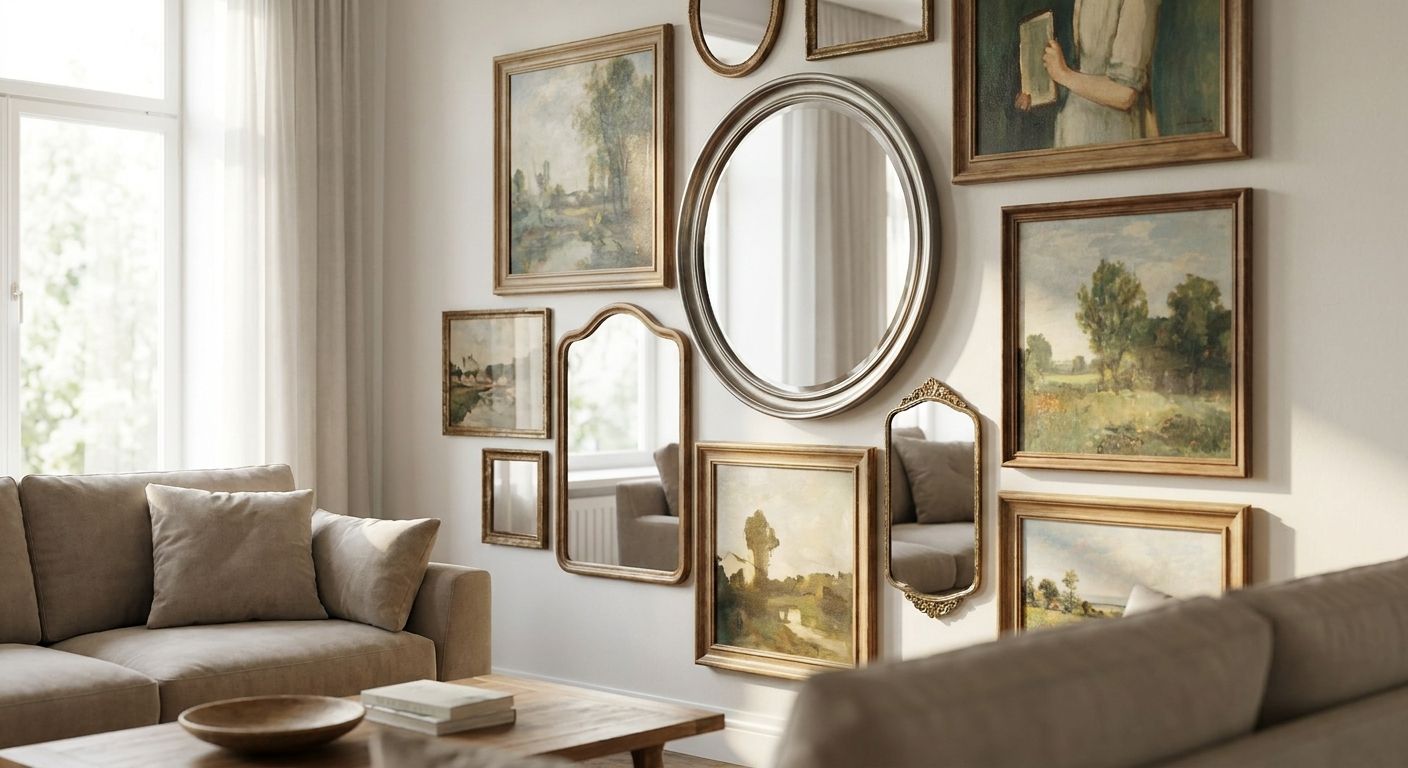
Mixing canvas art and mirrors on the same wall multiplies light and adds depth to a room, but get the ratio wrong and the wall looks like two different projects stapled together. This guide breaks down the exact order of operations, spacing rules, and finishing touches for layering canvas art and mirrors so the wall reads intentional in 2026, not accidental.
- Layering canvas art and mirrors works in 2026 when one anchor piece leads and everything else builds outward from it.
- Keep mirrors to roughly 30-40% of the wall's total pieces so reflections don't compete with the art.
- Gioia Wall Art's canvas prints pair cleanly with a single accent mirror when frame finishes match.
- Space every piece 2-3 inches apart and skip hanging a mirror directly across from a window.
- Verdict: hang the anchor first, canvas art second, mirror last — reversing that order is the most common mistake.
Why this matters
A wall that mixes canvas art and mirrors bounces light into rooms that would otherwise feel closed off, which is why the combination shows up so often in 2026 interior moodboards for small apartments and low-light rooms. The catch is that mirrors reflect movement and glare, while canvas art holds still — hang them without a plan and the eye never settles anywhere. Getting arranging a gallery wall right for a mixed layout means treating the mirror as a piece of art first and a functional object second.
Most failed attempts at layering canvas art and mirrors come down to one thing: too many competing focal points with no clear hierarchy. Fix the hierarchy and the rest of the layout falls into place fast.
What you'll need
- Measuring tape and a level
- Kraft paper or newspaper to trace piece outlines
- Painter's tape (low-tack, for the paper templates)
- One anchor canvas print, sized 24x36 inches or larger
- One or two mirrors, framed to complement the canvas frames
- 2-4 smaller canvas prints for supporting pieces
- Picture hangers rated for each piece's weight, plus a stud finder if any piece exceeds 15 pounds
- A pencil for marking hanger points
The steps
1. Map the wall with paper templates
Trace every piece — canvas and mirror — onto kraft paper and tape the outlines to the wall before a single nail goes in. This step accomplishes the one thing photos of finished walls never show you: how much negative space is actually left once everything is up. Leave 2-3 inches between every template edge, and step back 6-8 feet to check the composition from normal viewing distance. Common mistake: skipping the paper stage and eyeballing it directly on drywall, which almost always ends in extra nail holes.
2. Choose your anchor piece
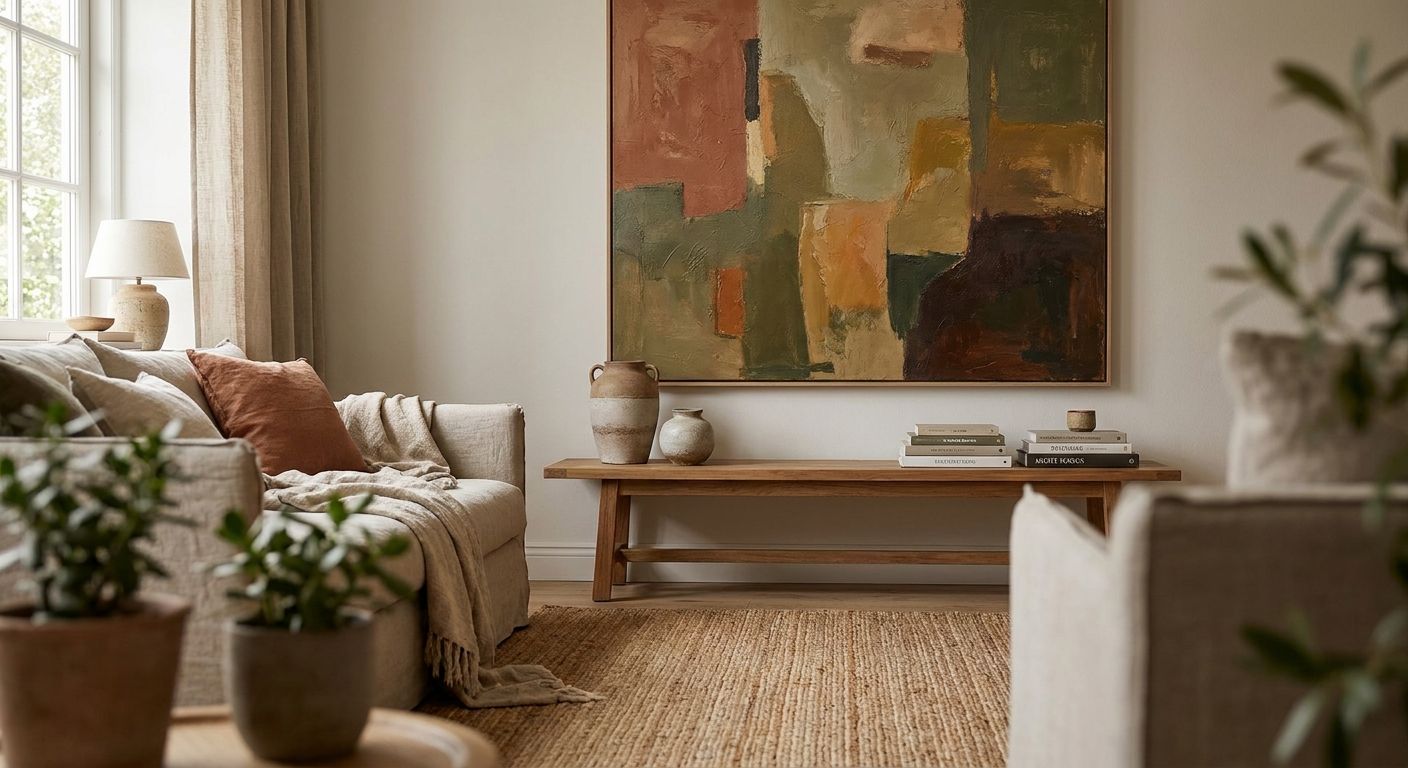
The anchor is the largest, boldest piece on the wall and it goes up first — everything else is arranged around it, never the reverse. For most living room and entryway walls, that means a canvas print at least 30% larger than any other single piece in the layout. Choosing the right canvas size for this role matters more than any other decision in the layout, because an undersized anchor gets visually swallowed by a mirror next to it. Expected outcome: once the anchor is placed, the rest of the wall should feel like it's responding to it, not competing with it.


3. Decide mirror count and placement
One mirror reads as an accent; two mirrors on the same wall start to feel like a bathroom vanity setup unless the wall is unusually large. Keep mirrors to roughly 30-40% of the total piece count and never place one directly opposite a window — the glare bounces straight back at anyone sitting in the room. Why it matters: a mirror's job here is to add depth and catch ambient light, not to dominate the eye line the way the anchor canvas does.
4. Test-lay the layout on the floor
Before committing to wall placement, lay every piece — mirrors included — on the floor in the exact arrangement you're planning. This catches spacing problems while they're still cheap to fix. Photograph the floor layout from above; it's the fastest way to spot a lopsided composition before it's on the wall in 2026's most trafficked room.
5. Hang the anchor first
Mark the anchor's center point at 57 inches from the floor — the standard eye-level height used in most gallery installations — then hang it using hardware rated for its actual weight. Hanging canvas art without damaging walls starts with picking the right hanger for the frame's depth, not just its size. Common mistake: centering the whole cluster at 57 inches instead of just the anchor piece, which pushes supporting pieces too high.
6. Layer outward with canvas art
Work outward from the anchor in a loose spiral, alternating orientation and size so no two adjacent pieces match exactly. Keep the 2-3 inch gap consistent across the whole cluster — inconsistent spacing is the fastest way to make a layered wall look unplanned. Expected outcome: the canvas pieces should form a shape (rectangle, cross, or loose grid) with the mirror slot still open.
7. Add the mirror last
The mirror goes up after every canvas piece is confirmed level, because its reflective surface makes it the easiest piece to accidentally over-center. Slot it into a gap that's slightly smaller than its actual size to make it feel tucked into the composition rather than bolted on as an afterthought. Why it matters: mirrors hung last let you see exactly how much reflected light and movement the finished wall will carry.
8. Adjust and finalize spacing
Step back 8-10 feet, check every piece against a level, and nudge anything that's more than half an inch off. Fine-tune the 2-3 inch gaps one more time now that the mirror is reflecting the room and drawing extra attention to unevenness. Common mistake: stopping at 'close enough' — mirrors expose crooked framing faster than canvas ever will.
Troubleshooting
- Glare washes out the mirror during the day: Move the mirror to a wall perpendicular to the window instead of facing it directly.
- The wall feels cluttered: Remove the smallest piece in the cluster first — density usually drops the most from cutting the weakest link, not the biggest one.
- Frame finishes clash: Match metals (all warm gold or all black) between the mirror frame and at least one canvas frame to tie the palette together.
- Pieces won't stay level: Swap single-nail hangers for two-point D-ring hardware, especially on any piece over 5 pounds.
- The mirror feels like an afterthought: Resize the gap it sits in — a mirror in a slot that's too generous reads as an accident, not a choice.
- Heavy anchor piece is slipping: Confirm the hanger is rated above the frame's actual weight and anchored into a stud, not drywall alone.
Tools and resources
- Canvas art sets for gallery walls — pre-matched sizing takes the guesswork out of the canvas side of the layout
- A stud finder and a torpedo level, non-negotiable for any wall with a mirror over 20 pounds
- Kraft paper templates, reused from the mapping step, for any future rearrangement
What to do next
Once the wall is finished, revisit the spacing every six months — canvas can shift slightly on its hanger, and mirrors show it faster than art does. If the current layout still feels unbalanced after adjustments, the fix is usually the anchor piece itself being too small for the wall, not the mirror placement.
FAQ
Is layering canvas art and mirrors a good idea in a small room?
Yes, layering canvas art and mirrors works especially well in small rooms because the mirror bounces light and makes the wall feel deeper. Keep the mirror share under 40% of the total pieces so the room doesn't feel like a fitting room.
How many mirrors should be on a gallery wall with canvas art?
One mirror is usually enough on a standard gallery wall; two only works on walls wider than 8 feet. More than two mirrors mixed with canvas art tends to compete with the art instead of supporting it.
What height should the anchor canvas print be hung at?
Center the anchor piece at 57 inches from the floor, the standard eye-level height used across most 2026 gallery wall installations. Supporting pieces and the mirror build outward from that center point.
Should the mirror go up before or after the canvas art?
Hang the mirror last, after every canvas piece is confirmed level. Mirrors reflect the room and expose uneven spacing faster than canvas art does, so they're easiest to place correctly at the end.
Can a mirror and canvas art share the same frame color?
Matching frame finishes between the mirror and at least one canvas piece ties the layout together visually. It doesn't need to be an exact match, but the metal tone (gold, black, or natural wood) should align.
What's the ideal gap between canvas art and a mirror on the same wall?
Keep 2-3 inches between every piece, mirror included, for a cohesive cluster. Wider gaps start to read as separate, unrelated groupings rather than one layered wall.
Does a mirror work as the anchor piece instead of canvas art?
A mirror can anchor a wall, but it needs to be noticeably larger than every other piece to hold that role. In most 2026 layouts, a large canvas print still works better as the anchor because it doesn't reflect glare from nearby light sources.
One last thing
The detail that makes or breaks a mixed wall isn't the mirror size — it's frame depth. A mirror with a deep, chunky frame next to a thin canvas float frame throws off the whole composition even when every measurement is correct, so match frame depth within a half inch across the cluster before worrying about anything else.