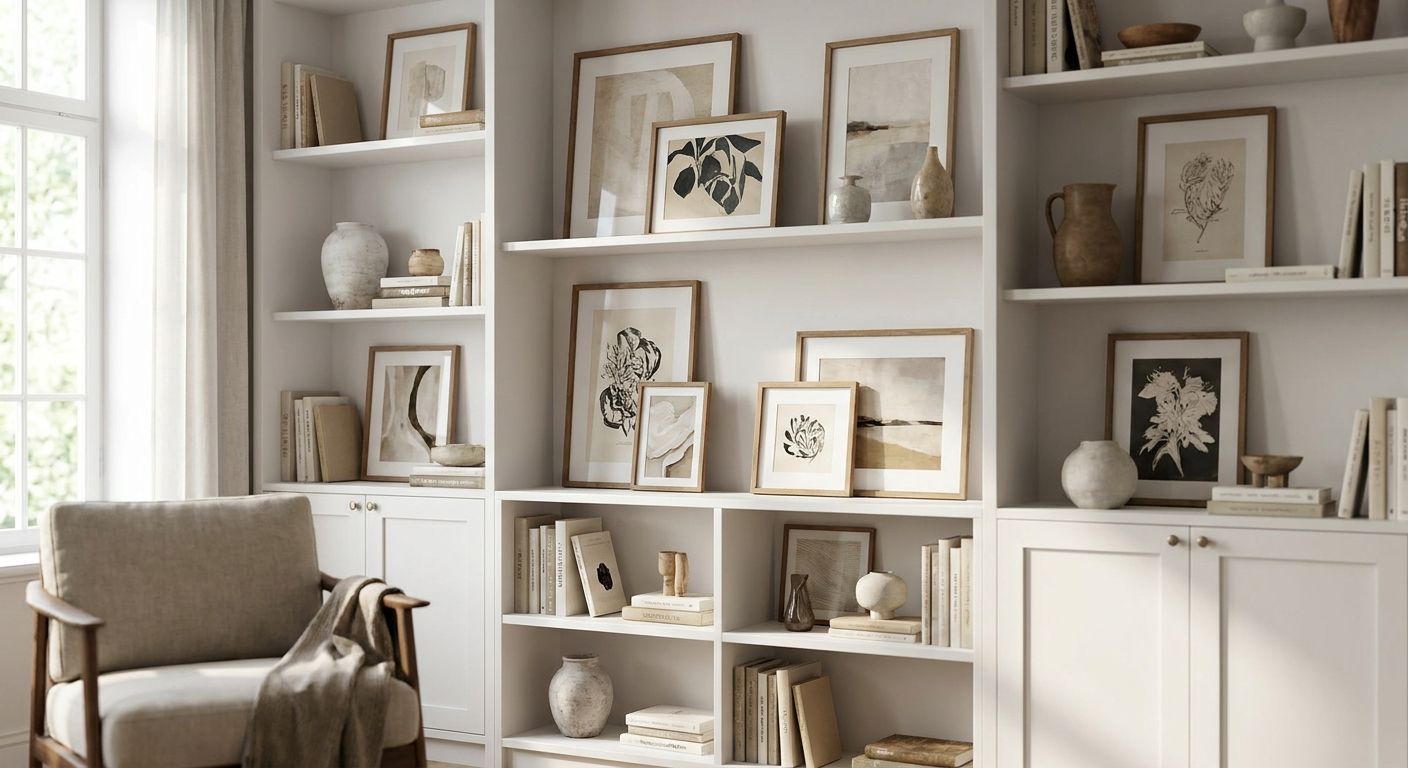
Framed wall art for built-in shelving displays is art sized and styled to lean, hang, or anchor across built-in bookcases and cabinetry, with the goal of turning open shelving into a styled vignette instead of a shelf of random stuff. Built-ins have fixed depth and width, and the art shares visual space with books, boxes, and objects, so it has to work smaller and layer better than a single statement piece over a sofa.
- Framed wall art for built-in shelves works best in a mixed set of 2-3 sizes, not one oversized piece.
- Leaning frames on shelf ledges read more curated in 2026 than frames hung flush against the back panel.
- Square-format framed prints fit built-in cubby openings without trimming or awkward gaps.
- Reserve one larger framed piece for the wall beside or above the unit as the anchor, then keep shelf art small.
Why framed wall art matters for built-in shelving displays
Built-ins are permanent. Unlike a gallery wall you can rehang, a shelving unit locks you into fixed depth, fixed width, and a hard edge where the shelf meets the wall behind it. That's exactly why so many built-ins end up half-styled: the owner buys one frame, props it in the middle, and stops.
A framed art selection for a home library faces the same constraint — the art has to share space with spines, boxes, and objects rather than owning the whole wall. Built-in shelving is the same problem in a different room: the art is one ingredient in a shelf, not the whole shelf.
Gioia Wall Art sells framed prints, canvas prints, and posters in enough sizes and formats to cover both jobs on the same wall — small leaning pieces for the shelf and one larger anchor piece for the wall beside it. That range matters here because built-ins rarely need one type of art; they need two or three working together.
How to style framed wall art for built-in shelves
Measure your shelf openings before you shop
Built-in proportions vary more than people expect, and a frame that looks right in a photo can be two inches too deep for your shelf.
- Depth of each shelf (most built-ins run 10 to 14 inches deep)
- Width of the narrowest cubby you plan to style
- Vertical clearance between shelves
- Whether the shelves are fixed or adjustable
- Any trim, crown moulding, or lighting that eats into the opening
Lean instead of hang on open shelves
Frames that lean against the back panel look collected. Frames hung flush against the back panel look like a photo wall that got shrunk down.
- Use an easel-back frame or a simple lip to prop pieces against the back panel
- Keep leaning frames at roughly 60 to 70% of the shelf width so books can flank them
- Angle small frames slightly forward instead of flush against the wall
- Reserve wall-mounted frames for the space directly beside or above the unit
- Skip glass-front leaning frames near reading lamps to avoid glare
Mix framed art sizes across the shelf run
One size on every shelf reads flat. A mix of small and mid-size pieces, spaced out with objects, reads styled.
- Pair a mid-size framed print with 2-3 smaller pieces on the same shelf
- Alternate art with stacked books, a vase, or a small object every other cubby
- Repeat one frame finish or mat color across the run to tie the shelves together
- Use square-format framed prints for cube-style cubbies so the piece fills the opening instead of floating in it
- Leave one shelf mostly empty as a visual rest


Anchor the wall around the built-in
The shelf holds small, quiet pieces. The wall beside or above it holds the one piece that carries the room.
- Choose one larger framed piece for the wall space beside or above the unit
- Size the anchor to roughly two-thirds the width of the open wall section
- Match the anchor's frame tone to the built-in's wood or paint finish
- Keep the anchor's color palette tied to at most two of the shelf pieces
- Avoid a second oversized piece competing with the shelf styling
For sizing that piece correctly, choosing the right canvas size for your wall walks through the math against your actual wall dimensions.
Match frame finishes to your built-in's hardware and wood tone
- Black or bronze frames read modern against white built-ins
- Natural wood frames blend into stained cabinetry instead of standing out
- Brass or gold frames pair well with glass-front or lit built-ins
- Mixed metals across four or more frames start to look accidental — cap it at two finishes
Rotate a few pieces with the seasons
A shelf that never changes stops getting noticed. Rotating two or three smaller pieces keeps the built-in feeling current without redoing the whole wall every time.
- Swap 1-2 smaller framed pieces per season and leave the anchor piece alone
- Store the rotation in a flat box or portfolio sleeve, not stacked loose against each other
- Photograph the shelf styling before swapping so you can rebuild it later
- Keep a rotation of no more than 3-4 spare framed pieces to avoid clutter creeping back in
If you want a fuller system for this, arranging a gallery wall with framed art covers spacing and layout logic that applies just as well to a shelf run as it does to a wall.
Which type of framed art works best for your shelving?
| Option | Best for | Key limitation |
|---|---|---|
| Framed canvas print | Anchor piece beside or above the unit | Bulkier depth can crowd a shallow shelf if leaned |
| Framed fine art print | Leaning on shelf ledges among books | Glass front picks up glare near reading lamps |
| Framed poster | Filling extra cubbies on a budget | Thin mats can look flat next to textured objects |
| Original painting | A single statement piece for one shelf | Fixed sizing may not match your shelf module width |
Verdict: for most built-ins, a framed fine art print or small canvas leaning on the shelf plus one larger framed canvas as the wall anchor beats trying to make one format do both jobs.
Common mistakes people make styling built-in shelves
- Buying one oversized frame instead of a mixed set. A single large piece flattens the shelf into one focal point and leaves every other cubby looking unfinished.
- Ignoring shelf depth. Frames deeper than the shelf stick out past the edge and get knocked loose the first time someone dusts.
- Hanging every piece instead of leaning some. An all-hung shelf loses the layered, collected look built-ins are supposed to have.
- Matching every frame finish exactly. A shelf styled with one metal tone and one wood tone looks intentional in 2026; four different finishes look like leftovers from four different rooms.
- Skipping negative space. Filling every inch removes the visual pause that makes the styled pieces actually stand out.
“Pull two pieces off a cluttered shelf and put them back after a week — most over-styled built-ins settle once the count drops from six pieces to four.”
FAQ
What size framed wall art fits built-in shelves?
Size leaning pieces to your shelf depth, usually 10 to 14 inches, and keep them at 60 to 70% of the shelf width. Reserve one larger piece for the wall beside or above the unit as the anchor.
Should I hang or lean framed art on built-in shelves?
Lean most pieces against the back panel among books and objects, and hang only the larger anchor piece on the open wall next to the unit. An all-hung shelf loses the layered look built-ins are meant to have.
How many framed pieces should I put on built-in shelving?
Two to three per shelf mixed with books, boxes, or a plant works better than filling every cubby. Leave at least one shelf mostly empty as a visual rest.
What frame finish works best with white built-ins?
Black or bronze frames read modern against white built-ins in 2026, while natural wood frames blend into stained cabinetry instead of contrasting with it.
Can I use canvas prints instead of framed art on shelves?
Canvas prints work well as the larger anchor piece beside or above the unit, but their depth usually makes them too bulky to lean directly on a shelf ledge.
How do I avoid a cluttered look on open shelving?
Leave at least one shelf mostly empty, cap frame finishes at two across the whole run, and alternate art with objects instead of lining up frame after frame.
What's the best wall art for a built-in bookcase without glass doors?
Leaning fine art prints or small framed posters work well since there's no cabinet front, but keep them out of direct sun exposure over time.
Should built-in shelf art match the room's main wall art?
Tie the palette to at most two colors shared with the room's main piece rather than matching exactly. An exact match looks like a set bought in one box, not a curated shelf.
One last thing
The fastest way to fix an over-styled built-in in 2026 isn't buying more art — it's removing two pieces and living with the gap for a week. Most shelves that feel cluttered have six or seven objects competing for attention; drop that to four and the framed pieces you kept finally get looked at instead of scanned past.