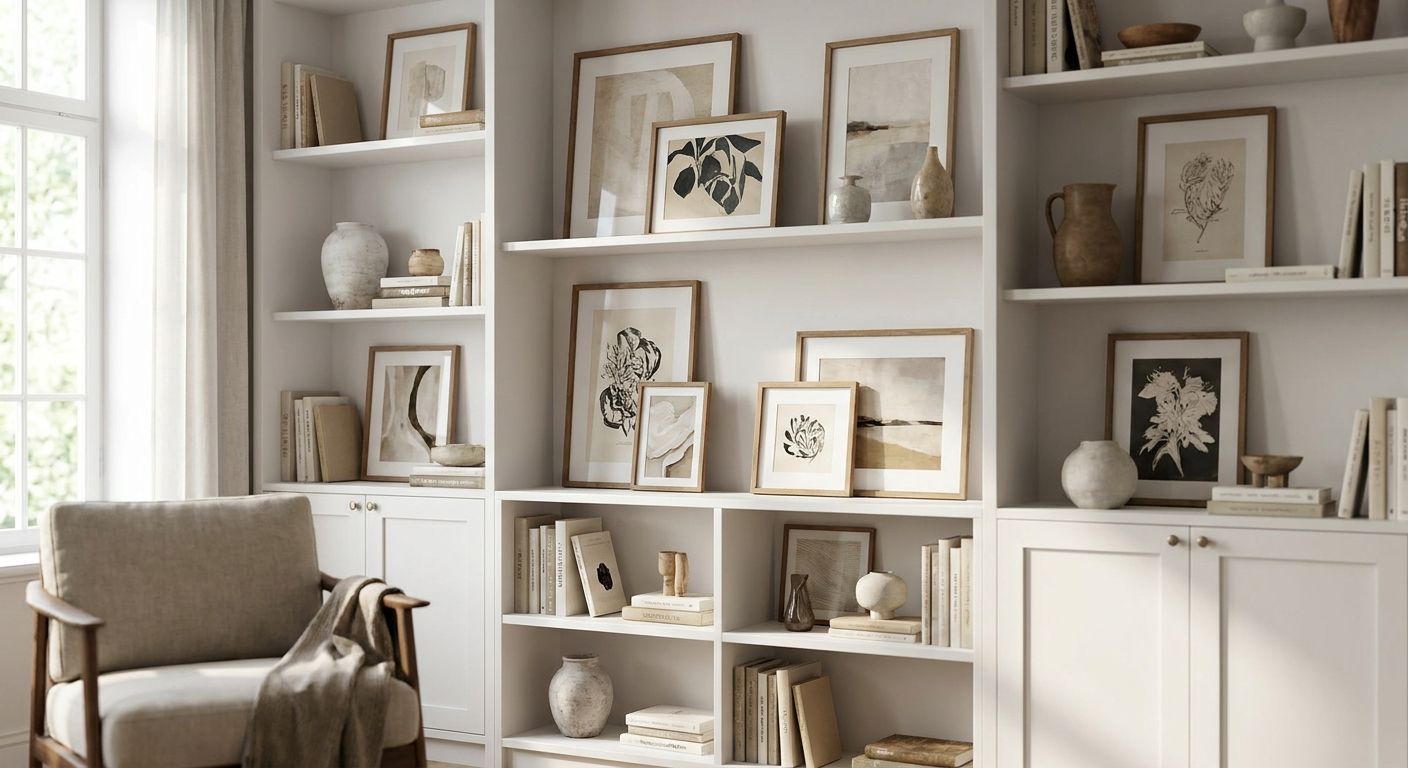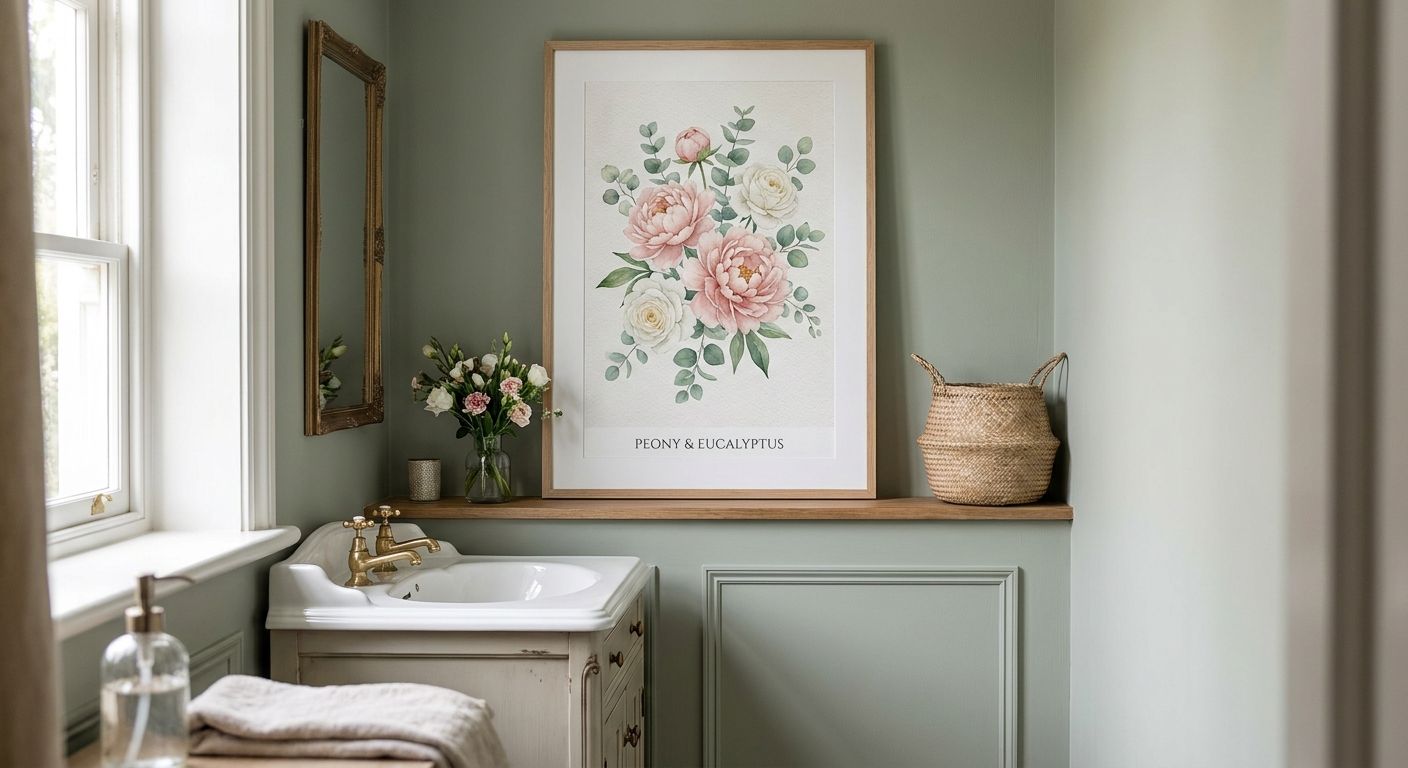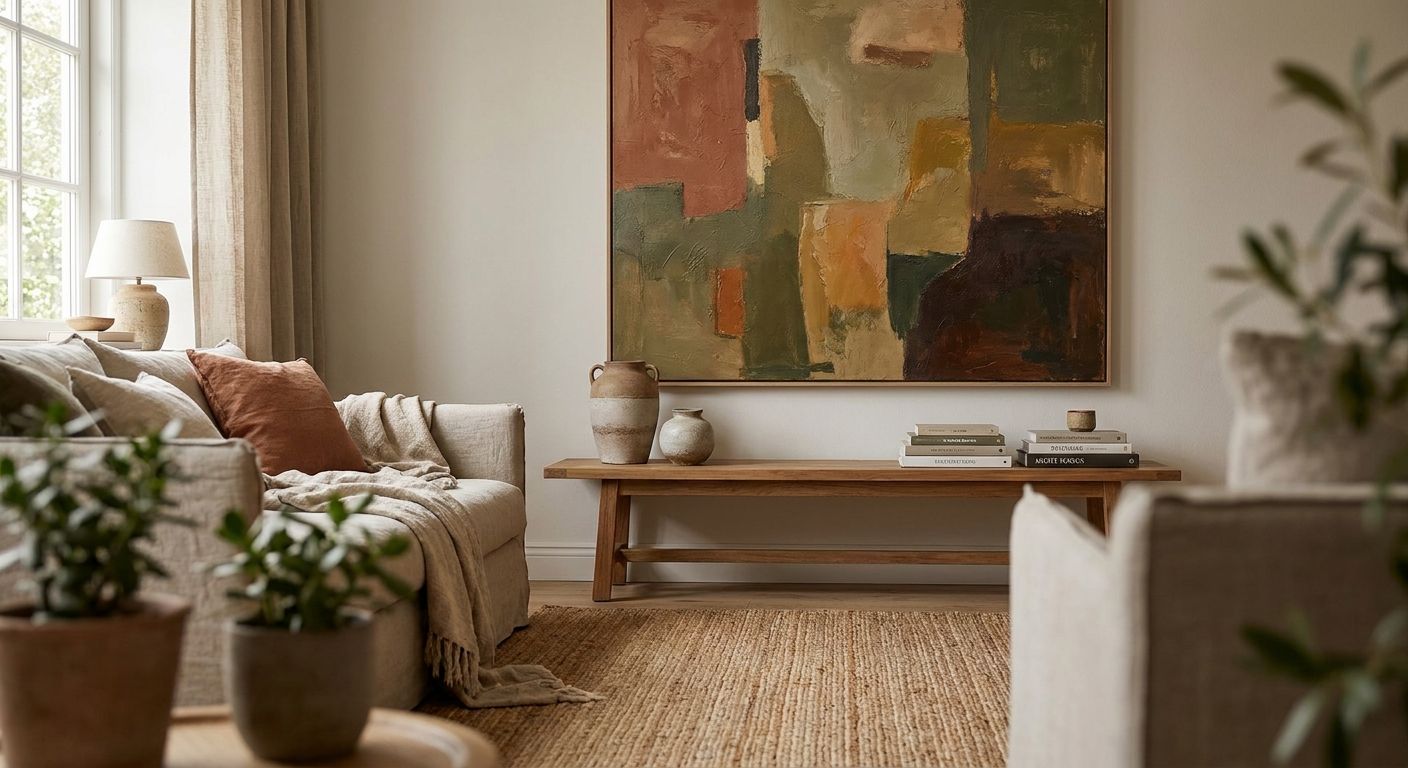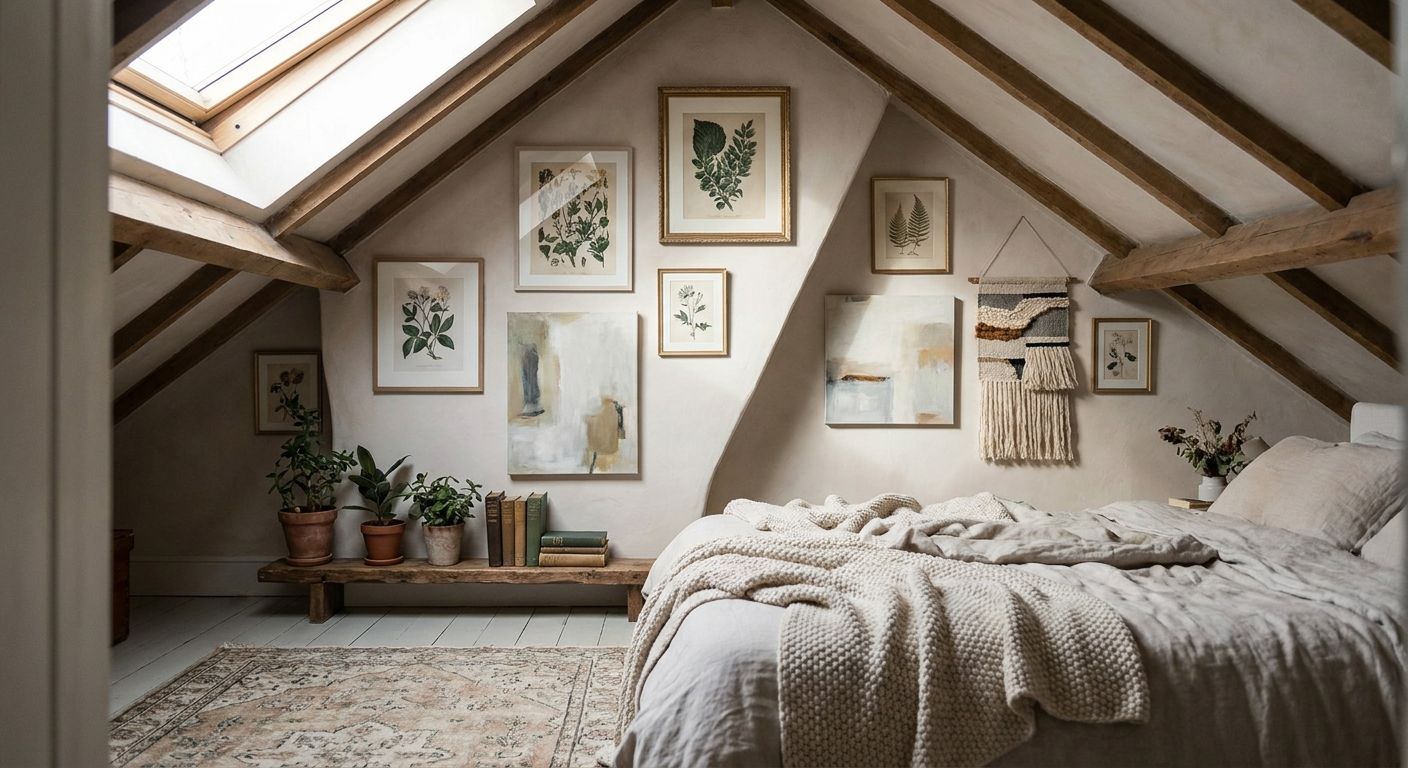
Attic and loft bedrooms come with slanted ceilings, dormer nooks, and walls that stop halfway up before the roofline takes over. Picking wall art for attic bedrooms means working with those angles instead of fighting them, and that's a different exercise than shopping for a standard four-square room.
- Wall art for attic bedrooms should be sized to the tall wall segment, not the slanted ceiling, in 2026.
- The 57-inch eye-level rule still applies even when a dormer or knee wall interrupts the space.
- Blue Floral Arrangement and Vibrant Sunset Landscape both suit low-light loft bedrooms: Buy.
- Skip oversized gallery walls on sloped ceilings — they crowd the room and fight the angle instead of working with it.
Why this matters
A loft bedroom's usable wall height often maxes out at four or five feet before the ceiling angles away, which means a print sized for a normal bedroom wall will get chopped off by the roofline or crowd the headboard. Getting the right canvas size for your wall sorted first saves you from buying twice. Get the scale and placement right in 2026 and a loft bedroom reads intentional and cozy rather than like storage space with a bed in it.
Who this is for
This guide is for anyone decorating a converted attic, a loft-style primary bedroom, or a guest room tucked under the eaves — the room with one full-height wall, a knee wall under three feet, and maybe a skylight instead of a window. If your ceiling has a pitch steeper than 30 degrees or your tallest wall is under six feet, keep reading.
What to look for in wall art for attic bedrooms
Vertical wall height, not ceiling height
Measure the tallest full wall in the room, usually the gable end, and size art to that dimension rather than trying to fill the sloped plane above it. A 24x36 canvas on a gable wall with 8 feet of clearance reads as a proper focal point; the same canvas crammed against a 5-foot knee wall looks squeezed.
Scale suited to narrower wall segments
Most loft bedrooms don't have one big open wall — they have several smaller segments broken up by the roofline. Medium prints in the 16x20 to 24x36 range fit these segments better than one oversized statement piece, unless you have a genuine full-height gable wall to dedicate to it.
Color that compensates for lower light
Dormer windows and skylights let in less ambient light than a standard bedroom window, so dark, heavily saturated pieces can make the room feel like a cave rather than a retreat. Warmer, lighter palettes — soft blues, creams, warm terracottas — bounce more light around a room that's already working with less of it.
A hanging method that respects angled walls
Sloped ceilings and knee walls mean standard stud patterns don't always line up where you'd expect, and pieces hung too close to the roofline edge feel like they're about to slide off. Reading how to hang canvas art without damaging walls before you commit to placement saves you patch-and-paint work later.
Style that matches the room's actual use
A loft used as a primary bedroom calls for a calmer, more grown-up palette than a loft used as a guest room or a teen's retreat. If your loft leans minimalist, Japandi-style bedroom art with its muted tones and quiet compositions tends to suit the low-ceiling, tucked-away feel of an attic better than busy maximalist prints.


Top picks for attic and loft bedrooms
The Calming Pick — Blue Floral Arrangement. Soft blue tones counter a dormer window's limited light, and the composition holds up at 179.99 in a medium canvas size that fits a knee-wall segment without crowding it. This is the print to hang across from the bed in a loft used as a primary retreat. Buy.
The Statement Pick — Vibrant Sunset Landscape. If your loft has one true full-height gable wall, this landscape's warm gradient gives that wall a genuine focal point instead of getting lost against the slope. At 179.99, it's priced to anchor a room rather than sit as a filler piece. Buy.
The Wildcard — Sleeping Black Cat. Moody and small in scale, this piece works in the tight reading-nook segment many lofts have under the eaves where a larger canvas simply won't fit. It won't suit every loft bedroom's palette, so check it against your existing linens first. Consider.
The Earthy Option — Vibrant Desert Landscape. Warm terracotta and sand tones suit a loft converted into a home office-bedroom combo where you want energy without brightness that competes with a laptop screen. It reads best on a wall with at least 6 feet of clearance. Consider.
What to avoid
- Oversized gallery walls on the sloped plane. A gallery wall needs consistent vertical space to breathe; a roofline chops that consistency and makes the whole arrangement look accidental. If you want a gallery wall effect, check extra-large statement canvas art for a single anchor piece instead of a multi-frame cluster.
- Heavy, ornate frames near the low ceiling edge. Bulky frames visually shrink an already-tight knee wall and draw the eye to exactly the spot where the ceiling is lowest.
- High-gloss finishes under a skylight. Glare off a glossy canvas under direct skylight sun makes the piece unviewable for part of the day — matte canvas or framed prints with anti-glare glass hold up better.
Verdict comparison
| Criteria | Blue Floral Arrangement | Vibrant Sunset Landscape | Sleeping Black Cat | Vibrant Desert Landscape |
|---|---|---|---|---|
| Best wall type | Knee wall segment | Full-height gable wall | Reading nook | Office-bedroom wall |
| Light compensation | High | Medium | Low | Medium |
| Verdict | Buy | Buy | Consider | Consider |
FAQ
What's the best wall art for attic bedrooms with sloped ceilings?
The best wall art for attic bedrooms is sized to the tallest full wall segment rather than the slanted ceiling itself. Medium canvases in the 16x20 to 24x36 range fit most loft wall segments without crowding the roofline.
How high should you hang art in a loft bedroom?
Center the art around 57 inches from the floor, the same standard used in any room, measured on the tallest available wall. On a knee wall under that height, center it as close to 57 inches as the wall allows.
Is a canvas print better than a framed print for an attic bedroom?
Canvas prints are lighter and easier to hang on the irregular stud patterns common in converted attics. Framed prints look more finished on a full-height gable wall but add weight that matters more on angled or knee walls.
Can you hang wall art directly on a sloped ceiling?
You can, but it's rarely the best move — a piece hung on the slope itself tends to look tacked-on rather than intentional. Reserve the sloped plane for a small accent and save your main piece for a vertical wall.
What colors work best for a low-light loft bedroom?
Soft blues, creams, and warm terracottas work best because they reflect more of the limited natural light dormer windows and skylights let in. Heavily saturated dark palettes can make an already dim loft feel smaller.
How much wall art does a small loft bedroom need?
One anchor piece over the bed and a smaller accent in a reading nook is usually enough for a loft bedroom. Cramming multiple large pieces into a space broken up by rooflines tends to look busy rather than curated.
Does wall art size need to match furniture below it in a loft?
Yes — the general rule is that art should span roughly two-thirds the width of the furniture beneath it, such as a headboard. That ratio holds even when the wall itself is shorter than a standard bedroom wall.
What's a good gift-worthy wall art style for a loft guest bedroom?
Coastal and Japandi styles tend to read as calm and welcoming in a loft guest bedroom without clashing with whatever the host has already chosen for the rest of the house. Both styles favor muted palettes that work with limited natural light.
One last thing
The single biggest mistake in loft bedrooms isn't color or style — it's measuring the ceiling instead of the wall. Once you commit to sizing art off the vertical wall segment and not the roofline, the rest of the decisions (frame weight, palette, placement) get a lot easier in 2026.