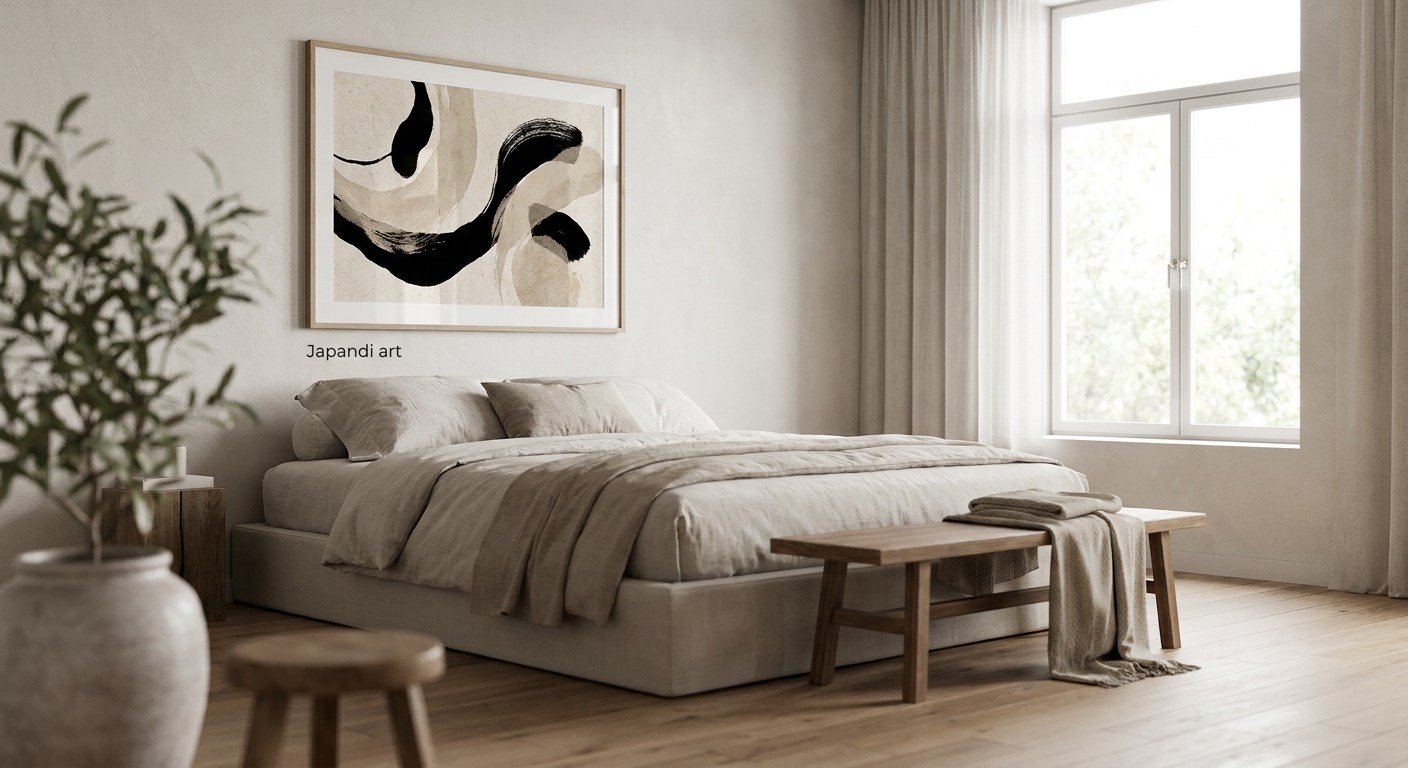
Japandi bedrooms live on restraint — muted tone, honest materials, and one piece of art doing the work instead of five loud ones. This guide covers what actually reads as Japandi versus what just looks beige, plus specific picks worth hanging above the bed in 2026.
- Japandi art works when palette, texture and scale all point the same direction — muted, organic, restrained.
- Meditation Circles B and Touch02 from Gioia Wall Art both read as Japandi at 179.99 dollars each — Buy.
- Skip saturated cityscape prints like I Love You Copenhagen for this look — the color contrast fights the room.
- Size art to 60-75% of headboard width; a queen headboard runs about 60 inches wide, so aim for 36-45 inches of art.
Why this matters
Japandi isn't a trend that's fading in 2026 — it's the default answer for anyone tired of maximalist gallery walls and wants a bedroom that actually feels restful. The wrong art print undoes that in seconds: one piece with saturated color or a busy scene, and the whole room reads cluttered even if the furniture is minimal. Getting japandi art right is a palette and scale decision more than a taste decision, and that's exactly where most buyers guess wrong.
Who this is for
This guide is for anyone furnishing a bedroom around Japandi principles — low platform beds, natural wood, linen bedding, a palette that stays in the sand-to-charcoal range. You're not looking for statement art. You're looking for a piece that disappears into the calm of the room while still giving the wall something to hold onto. If your bedroom already leans Scandinavian-minimalist or wabi-sabi, you're the exact buyer this applies to.
Browse the full wall art collection at Gioia Wall Art before you commit — seeing the full range of tone and texture side by side makes the muted pieces easier to spot.
What to look for in japandi art for a bedroom
Muted, earthy palette
Japandi rooms sit in a tight tonal band — oatmeal, clay, charcoal, soft moss. Art with even one saturated color (a hot pink, a bright royal blue) breaks that band and becomes the loudest thing in the room. Test any print against your bedding and bed frame tone before buying, not against the wall color alone.
Organic or abstract motifs over literal scenes
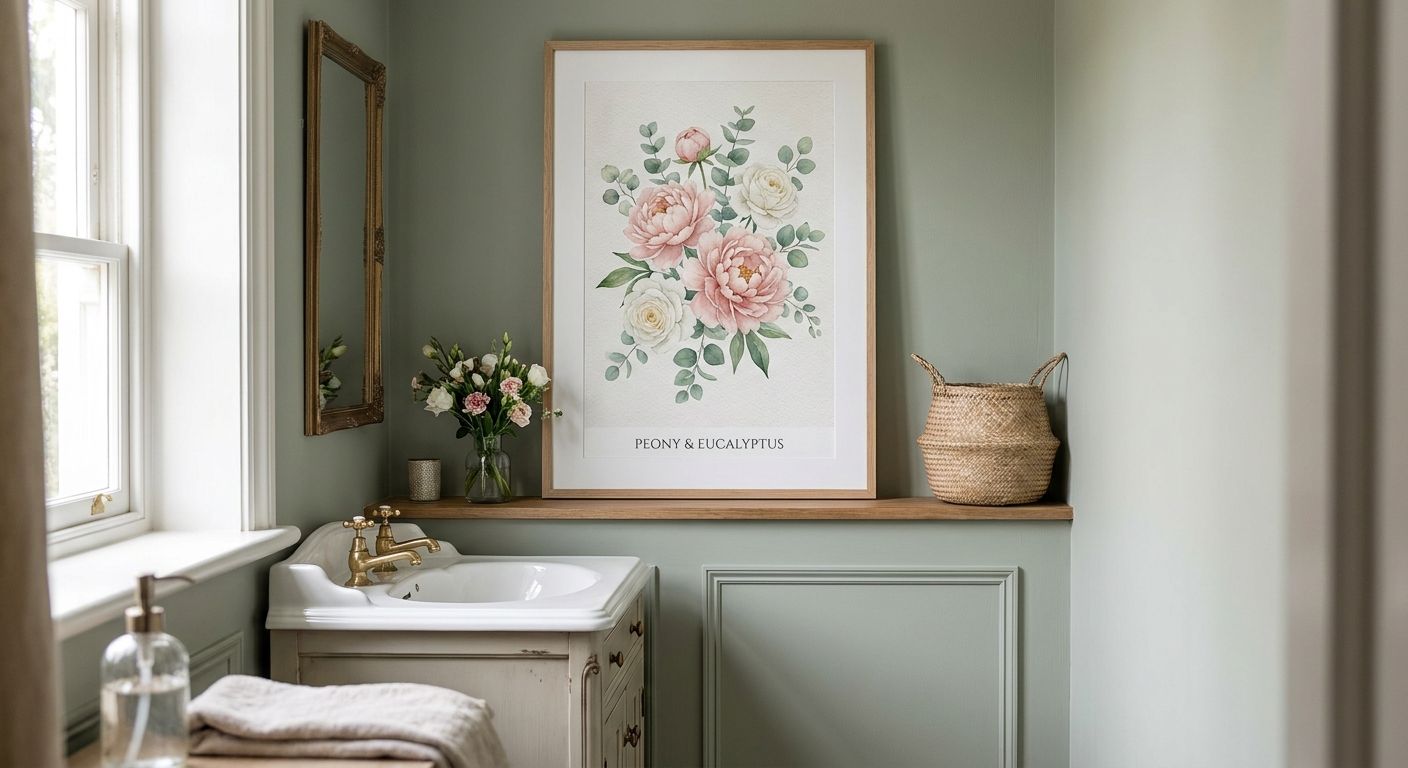
A literal skyline or busy floral bouquet pulls focus and reads as narrative art, not mood art. Japandi bedrooms want shapes — circles, curved lines, textured fields — that read as calm rather than as a story you have to look at twice.
Matte finish and thin, natural framing
Glossy canvas or a thick black frame contradicts the wabi-sabi materials underneath the piece. Look for matte canvas finishes or thin oak, ash or unfinished wood framing — anything that echoes the natural wood already in the room. It's a small spec, but it's the difference between art that fits and art that fights the furniture.
Scale restraint
Japandi doesn't do oversized statement walls. One piece sized to roughly 60-75% of your headboard width is the standard interior-design rule of thumb, and it holds here too — a queen headboard runs about 60 inches wide, so you're aiming for a print in the 36 to 45 inch range, not a floor-to-ceiling mural.
To dial this in for your specific bed and wall, choosing the right canvas size walks through the math room by room.
Negative space in the composition
A good Japandi print has breathing room built into the image itself — not just the wall around it. A piece that's edge-to-edge texture or pattern loses the calm effect no matter how muted the color is.
Color palette coordination with the room
Even a technically "muted" print can clash if its undertone runs warm against a cool-toned room, or vice versa. If you're unsure how to test this before buying, matching wall art to your room's color palette covers the undertone-matching step most buyers skip.
Top picks for japandi bedrooms
Meditation Circles B - Portrait 2 — the safe pick. Repeating circular forms in a muted tonal palette, priced at $179.99. This is the closest thing to a default-correct Japandi print in the current catalog — abstract, restrained, and it reads calm from across the room. Buy.
Touch02, Style B — the texture pick. A soft, organic abstract composition at $179.99 that leans into visible texture rather than color contrast, which suits the wabi-sabi side of Japandi specifically. If your room is already very neutral and needs one piece with tactile interest instead of more color, this is the one. Buy.
Geometry, Style B — the structured pick. Subtle geometric lines at $179.99 for a bedroom that wants a bit more visual anchor without breaking the muted palette rule. It reads more architectural than the other two, which works if your headboard or furniture already has strong lines. Consider.


For a wider abstract range beyond these three, abstract wall art for minimalist interiors covers more compositions in the same restrained register.
What to avoid
- Bright cityscape prints. Pieces like I Love You Copenhagen or SunriseIn Copenhagen are gorgeous, but the saturated skyline color contrast pulls hard against a muted Japandi palette — better suited to a living room or entryway than a Japandi bedroom.
- Heavy black frames. A thick black gallery frame reads industrial-modern, not Japandi. Stick to thin natural wood or unframed canvas edges.
- Oversized single statement pieces. Anything sized past 75% of your wall or headboard width overwhelms the calm the rest of the room is built around — even if the print itself is muted in tone.
Verdict comparison
| Pick | Palette | Texture | Frame style | Verdict |
|---|---|---|---|---|
| Meditation Circles B - Portrait 2 | Muted tonal | Smooth, layered | Canvas or thin frame | Buy |
| Touch02, Style B | Neutral, organic | High texture | Canvas | Buy |
| Geometry, Style B | Muted, structured | Low texture | Canvas or thin frame | Consider |
| I Love You Copenhagen (avoid for this use) | Saturated | Flat | Standard | Skip |
FAQ
What is Japandi wall art?
Japandi wall art blends Japanese wabi-sabi restraint with Scandinavian minimalism — muted, earthy tones, organic or abstract shapes, and matte finishes over gloss. It avoids bright color and busy composition in favor of calm, negative-space-heavy imagery.
What size japandi art should go above a bed?
Size the piece to roughly 60-75% of your headboard width. For a standard queen headboard around 60 inches wide, that puts you in the 36 to 45 inch range for the print itself.
Is Japandi wall art the same as minimalist wall art?
They overlap but aren't identical. Minimalist art can be stark black-and-white or high-contrast, while Japandi art specifically stays within warm, earthy, muted tones and favors organic texture over pure geometric starkness.
How much does japandi-style canvas art cost in 2026?
Canvas prints in this style typically run around $179.99 at Gioia Wall Art, in line with standard canvas print pricing across the catalog in 2026.
Should japandi bedroom art be framed or unframed canvas?
Either works, but if you frame it, choose thin natural wood over thick black or ornate frames. A heavy frame contradicts the restrained materials the rest of a Japandi room is built around.
Can I use color in a japandi bedroom's wall art?
Yes, but keep it in the muted, earthy range — clay, sand, moss, charcoal. Avoid saturated primary colors or high-contrast prints, which read as statement pieces rather than mood-setting art.
What's better for Japandi — abstract or nature-themed prints?
Both work if the palette and texture stay muted. Abstract compositions with negative space tend to be the safer default, while nature-themed prints work as long as they're rendered in soft, tonal color rather than bright realism.
One last thing
The fastest tell for whether a print will actually work in a Japandi bedroom isn't the subject matter — it's whether you can still name the dominant color of the room after hanging it. If the art becomes the answer instead of the walls or bedding, it's too loud for the style, no matter how "neutral" the product listing calls it.