A windowless room reads smaller, darker and flatter than it actually is — the right wall art fixes all three problems without touching the electrical panel. This guide breaks down what actually works for basements, walk-in closets, interior offices and any room missing a window, and what looks right in a photo but falls flat on the wall.
- Wall art for windowless rooms works best with warm, high-contrast palettes that fake daylight — skip moody monochrome.
- Large-scale landscape or abstract canvas prints add visual depth where a basement or closet has none.
- A light mat or white/gold frame reflects more ambient light than raw canvas in a room with no window.
- Gioia Wall Art's sunset and desert landscape prints work as stand-ins for a view in 2026 basement and office builds.
Why this matters
A windowless room loses two things a window normally gives you for free: a sense of depth and a shift in light through the day. Wall art can't replace either one, but the right piece fakes both well enough that most people stop noticing the gap. The wrong piece — small, dark, glossy — makes the room feel more closed in, not less.
Who this is for
This guide is for anyone decorating a basement family room, a walk-in closet, an interior home office, a windowless powder room, or any space where the only light source is a lamp or an overhead fixture. If you're staring at a blank wall in a room that never sees sun and wondering what size or palette actually helps, this is written for that exact problem. Gioia Wall Art's guide to wall art for a low-light, north-facing room covers the softer version of this same challenge — rooms with some light but not much of it.
What to look for in wall art for windowless rooms
Warm, high-contrast palettes over moody ones
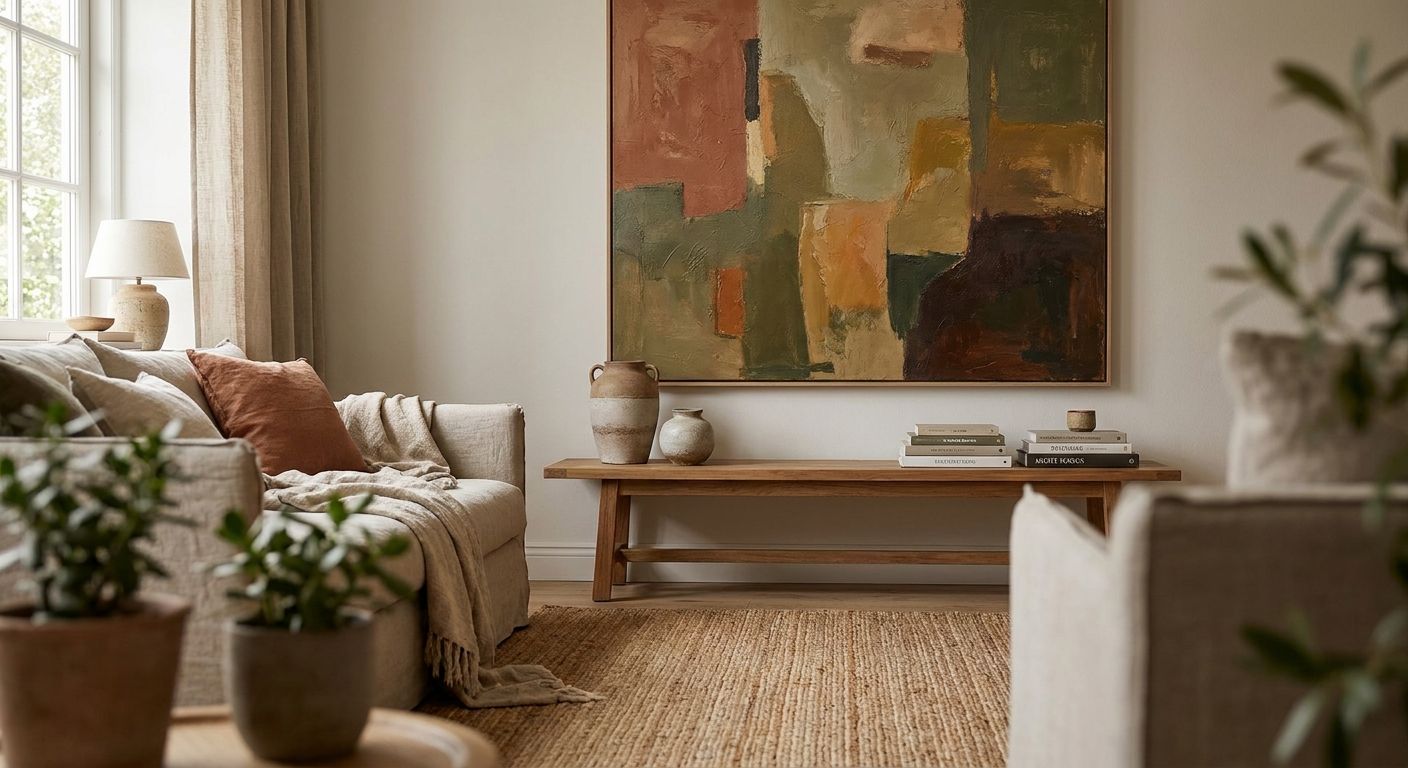
A windowless wall in 2026 needs contrast to register at all under artificial light — flat, low-saturation prints disappear into shadow by 6pm. Warm tones (rust, gold, terracotta, coral) read as sunlit even under a cool LED bulb, which is exactly the illusion you want.
Scale that actually fills the wall
A small print on a big blank wall shrinks the room further; a piece sized to the wall does the opposite. The standard rule of thumb — art should span roughly two-thirds the width of the furniture or wall section below it — matters more in a windowless room because there's no window to break up the expanse.
Implied daylight scenes
Landscapes, skies, botanicals and coastal scenes give the eye something a window would normally provide: a sense of somewhere else, lit by something other than a bulb. This is the single most effective trick for a basement or an interior office with zero natural light.
Reflective finish and light framing
A glossy canvas under a single overhead fixture throws hard glare; a matte finish or a light-colored mat softens that same light and spreads it. White, gold or light-wood frames bounce more ambient light back into the room than black frames do.
Placement height paired with a light source
Standard gallery height puts the center of the piece around 57 inches off the floor — but in a windowless room, pair that placement with a picture light or an uplight. Art with no light source pointed at it just becomes another dark rectangle after sunset, which in a windowless room is basically all day.
Room-specific durability
Basements run humid; closets run tight and dusty. Canvas holds up better than paper-based posters in either environment, and framed prints under glass are easier to wipe down in a walk-in closet than an open canvas.
Top picks for windowless rooms
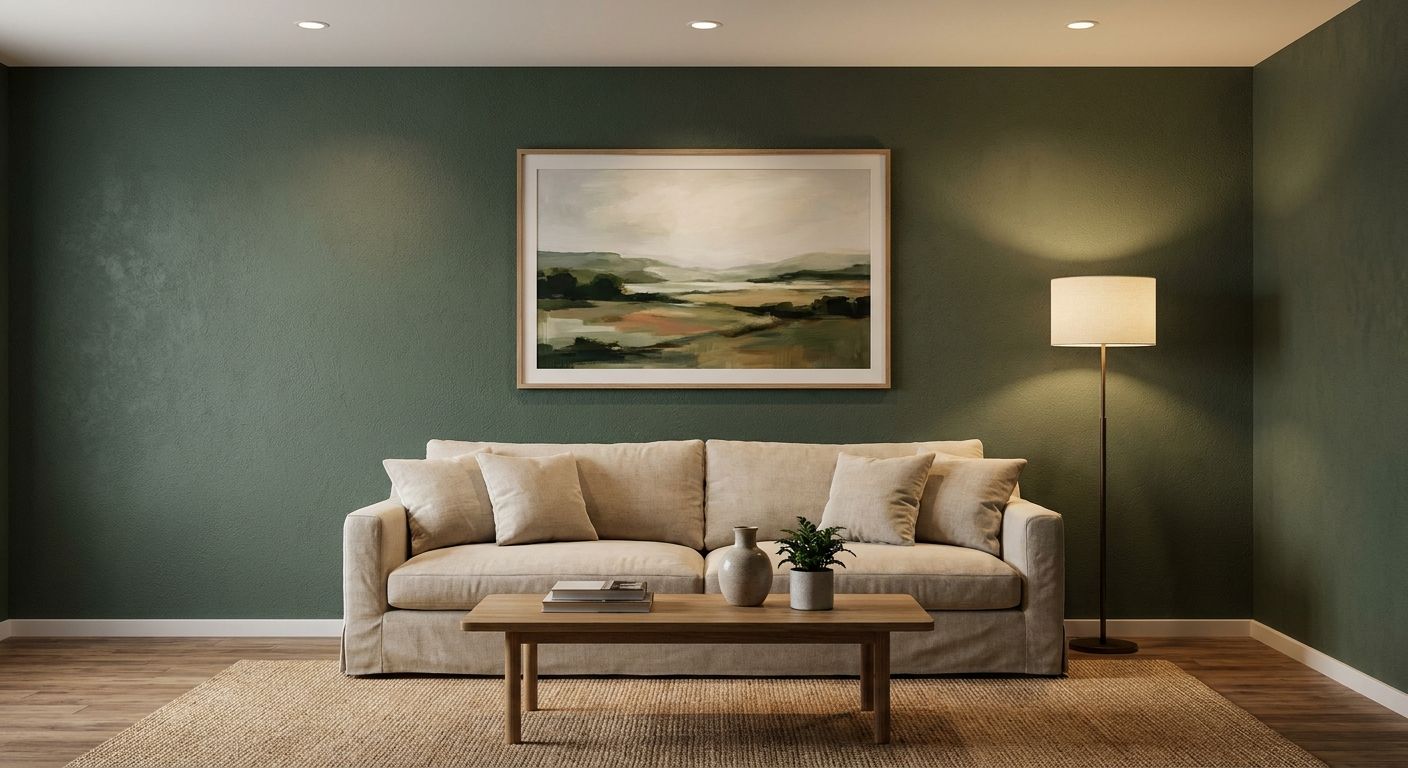
The depth-adder — basement family rooms. A large-scale landscape or desert scene, hung at 40x60 inches or bigger, does the most work of any single piece in a basement because it's replacing an entire missing wall of windows. Gioia Wall Art's guide to wall art for basement family rooms breaks down sizing for exactly this problem. Buy if your basement ceiling clears 8 feet; a smaller room can go one size down and still get the effect.
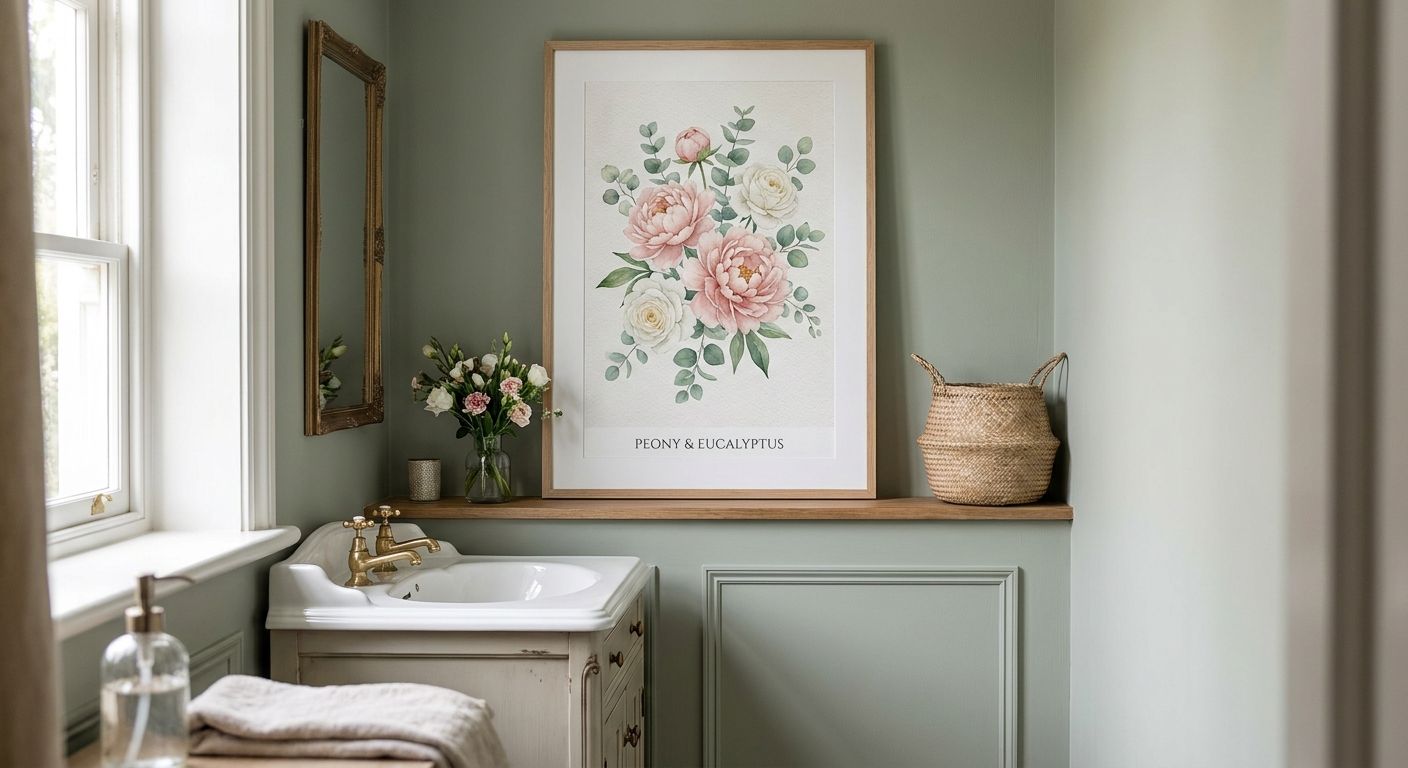
The light multiplier — walk-in closets. A framed floral or still-life print with a light mat, sized around 16x20 inches, reflects more of the closet's overhead light than a raw canvas does in a space this tight. Gioia Wall Art covers this directly in wall art for walk-in closets. Buy for closets under 60 square feet; go bigger for a walk-in that doubles as a dressing room.
The productivity boost — interior home offices with no window. A high-contrast abstract or a set of two coordinated prints behind the desk gives video calls a backdrop that doesn't look like a bare wall and gives your eyes something other than a monitor to land on between calls. Consider this over a single giant piece if the office also serves as a video-call backdrop — smaller, coordinated pieces read better on camera than one oversized canvas.
What to avoid
- Dark, monochrome or black-and-white statement pieces — they photograph well but absorb what little light a windowless room has instead of bouncing it back.
- High-gloss canvas under a single overhead bulb — the glare is worse in a windowless room than anywhere else in the house because there's no competing light source to soften it.
- One tiny print on a large blank wall — it emphasizes the size of the empty wall instead of filling it, which undercuts the whole point of hanging something in the first place.


Verdict comparison
| Room type | Best palette | Best format | Verdict |
|---|---|---|---|
| Basement family room | Warm sunset or desert tones | Large-scale canvas, 40x60+ | Buy |
| Walk-in closet | Soft florals, light mat | Framed print, 16x20 | Buy |
| Windowless home office | High-contrast abstract | Coordinated set of 2 | Consider |
| Interior powder room | Warm still life or metallic accent | Single statement piece | Consider |
| Any windowless room | Dark monochrome or glossy black-and-white | Any format | Skip |
FAQ
What's the best wall art for windowless rooms?
Large-scale landscape, desert or sunset scenes in warm palettes work best because they imply daylight a windowless room doesn't have. Pair them with a light-colored frame or mat to bounce more ambient light back into the space.
Is a mirror better than wall art in a windowless room?
A mirror bounces existing light but adds no color or scene; wall art adds both color and the illusion of depth a mirror can't fake. Many rooms benefit from one of each rather than picking only one.
How big should wall art be in a small windowless room?
Size the piece to roughly two-thirds the width of the furniture or wall section it hangs above, even in a tight room. A print too small for the wall makes a windowless room feel more cramped, not less.
Does canvas hold up in a humid basement?
Canvas holds up better than paper-based posters in a humid basement because it doesn't warp or yellow as fast. Keep it away from direct contact with damp walls and it should last through normal basement humidity swings.
What colors make a windowless room feel brighter?
Warm tones like terracotta, gold, coral and rust read as sunlit under artificial light, even without a real window. Cool, dark or monochrome palettes tend to flatten a room that already lacks natural light.
Should I add a picture light to wall art in a windowless room?
Yes — a picture light or uplight aimed at the piece keeps it visible and warm-looking after dark, which in a windowless room is most of the day. Without a dedicated light source, even a bright print goes flat under standard overhead lighting.
How much does wall art for a windowless room cost?
Prices vary by size, medium and framing, so check current pricing on the specific print you're considering. Canvas and framed prints in the 16x20 to 40x60 range cover most windowless rooms, from a closet to a basement family room.
One last thing
The single biggest mistake in a windowless room isn't the wrong print — it's hanging it under the same flat overhead light as the rest of the room. Add one picture light or a warm-toned lamp aimed at the piece and even a modest print starts doing the job a window used to do.