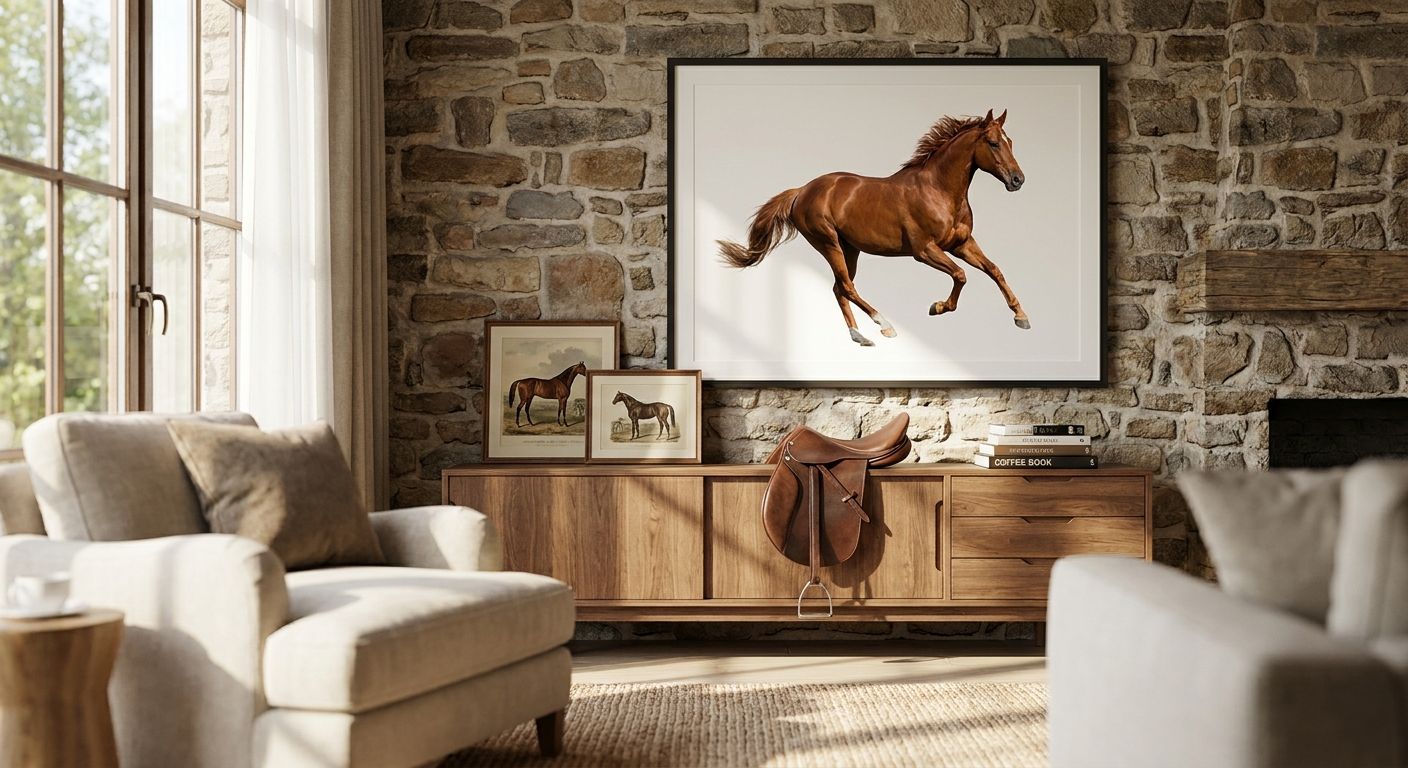
Wall art for horse lovers is decor built around equestrian subjects, horse breeds, tack, and riding scenes, chosen to bring the barn aesthetic into a home without turning a room into a tack shop. What separates this segment from generic animal decor is specificity: a rider wants the gait, the breed conformation, or the discipline (dressage, western pleasure, jumping) rendered accurately, not a generic "pretty horse" stock photo.
- Canvas prints in muted earth tones read as sophisticated equestrian decor, not novelty horse art.
- Match subject matter to riding discipline (western, dressage, hunter/jumper) for authenticity riders notice immediately.
- Gioia Wall Art's canvas size guide prevents the single most common mistake: undersizing over a mantle or sofa.
- Original paintings and framed prints both work for tack rooms; canvas holds up better against dust and humidity.
Why wall art matters for horse and equestrian lovers
Equestrian buyers shop decor differently than the average wall art customer. They're often furnishing two spaces at once, a primary residence and a barn office, tack room, or mudroom that also needs to look intentional. That doubles the decisions: what belongs in the living room versus what survives dust, humidity, and hoof traffic near a barn entry.
The canvas size guide matters more here than most categories, because horse portraits and full-body shots read as either grand or awkward depending on scale. A 16x20 canvas of a galloping horse over a console table looks like an afterthought; the same image at 30x40 becomes a statement piece.
Riders also buy for occasion more than most segments: gifts for a daughter's first horse, a retirement piece for a longtime trainer, or a housewarming print for a friend who just moved to a property with acreage. That gifting layer means the art needs to read as thoughtful, not generic, even at first glance.
How to choose wall art for horse and equestrian lovers
Define your equestrian aesthetic first
Before browsing, decide whether the space leans western ranch, English/hunt country, or elegant sporting estate. These three aesthetics use almost opposite color palettes and framing choices, and mixing them makes a room look uncoordinated.
- Western ranch: warm rust, saddle tan, weathered wood tones, rope or barnwood-style frames
- English/hunt country: hunter green, navy, brass accents, classic black or gold frames
- Elegant sporting estate: black-and-white photography, charcoal grays, minimal framing
- Modern farmhouse crossover: neutral linen backgrounds with a single bold horse silhouette
- Kids' or teen equestrian bedroom: brighter palettes, illustrated or watercolor horses instead of photoreal
Match subject matter to riding discipline
A dressage rider and a barrel racer are not shopping for the same image, and generic "wild mustang running through water" art misses both. Specificity signals the piece was chosen, not grabbed off a shelf.
- Dressage or hunter/jumper: profile shots showing correct form, over fences or in collection
- Western pleasure or ranch work: horse and rider working cattle, or a solo quarter horse portrait
- Racing fans: field shots at speed, or close-crop portraits of a signature breed like Thoroughbred
- Breed-specific buyers: look for art labeled by breed (Friesian, Andalusian, Appaloosa) rather than "horse, generic"
- Non-riders who just love horses: soft-focus pasture scenes or single-horse portraits read as approachable, not competitive
Size the piece to the wall, not the other way around
Undersizing is the single most common mistake in this category, because horse imagery has enough detail that a small print loses the texture of the mane and musculature that made the photo compelling in the first place.
- Above a sofa or console: art should span roughly two-thirds the width of the furniture below it
- Above a mantle: leave 4-6 inches of breathing room on each side of the mantle's width
- Tack room or barn office: a single large canvas reads better than three small ones in a working space
- Hallway or stairwell: a vertical portrait orientation suits a galloping or standing horse better than landscape crops
- Gallery wall: mix one large anchor piece with two or three smaller supporting prints
Pick a color palette that complements the room, not just the horse
A technically beautiful horse photo in the wrong palette fights the room instead of completing it. Pull two or three colors from the image itself and echo them in the room's existing textiles or trim.
- Sorrel or chestnut horses: pair with rust, terracotta, or warm wood tones already in the room
- Black or dark bay horses: pair with charcoal, navy, or deep green for a moody, refined look
- Grey or white horses: pair with soft neutrals, sage, or dusty blue for a calmer feel
- Painted or pinto horses: lean into higher contrast rooms with black-and-white or graphic patterns
- Barn or tack room walls: stick to warm neutrals so the art, not the wall, carries the color
Choose between canvas, framed print, or an original painting
Each format has a real tradeoff for equestrian buyers, and the choice usually comes down to where the piece hangs and how much upkeep the space gets.
| Option | Best for | Key limitation |
|---|---|---|
| Canvas print | Living rooms, hallways, tack rooms with moderate dust | No glass, so texture can dull faster in very humid barns |
| Framed art print | Formal living rooms, offices, gift-giving occasions | Glass adds glare in bright, south-facing rooms |
| Original painting | Statement pieces, milestone gifts, one-of-a-kind buyers | Higher cost, harder to size to an exact wall dimension |
| Poster (unframed) | Kids' rooms, dorm rooms, temporary rental walls | Least durable, shows wear fastest with handling |
Canvas is the practical default for most equestrian buyers in 2026 because it survives being knocked, doesn't need glass cleaning near a dusty entry, and holds up in gallery wall sets better than framed pieces do.
Hang and arrange it like a tribute wall, not a single accent
Riders often want more than one piece, since a single horse portrait can feel isolated where a small cluster tells a story about the whole barn.
- Anchor with one large horse portrait, then add two smaller supporting images (tack, ribbons, or a pasture scene)
- Keep spacing consistent, 2-3 inches between frames for a cohesive gallery look
- Use proper hanging methods so pieces stay level in a mudroom or entry that gets daily traffic
- Group by discipline or by horse if the collection covers more than one animal
- Leave one open slot for a future ribbon photo or new horse addition
Protect the piece if it's going near a barn or mudroom entry
Dust, humidity, and boots track more grit through a barn-adjacent entry than any other room in the house, so material choice matters as much as image choice.
- Canvas wipes clean easier than a framed print with glass that shows every fingerprint
- Avoid direct sun exposure near barn windows, which fades color faster than an interior wall
- Keep original paintings out of high-humidity tack rooms; save those for the main house
- A gloss or matte canvas coating resists dust buildup better than an unsealed poster print
Budget and buy with intention
Gifting occasions (a first horse, a retirement, a barn housewarming) push equestrian buyers toward pieces with real presence rather than the cheapest option available.
- Decide the wall and size first, then shop within that footprint instead of resizing a favorite image down
- Reserve original paintings for milestone gifts rather than everyday decor
- Buy canvas for anything going near a barn, tack room, or mudroom
- Check the current sizing and pricing on the product page before committing to a specific print
Gioia Wall Art's canvas catalog covers equestrian and pasture scenes in the same curated style used across its 6,000-plus print selection, so a rider furnishing both a house and a barn office can match palettes across rooms without hunting through multiple stores.
“Undersizing is the single most common mistake in equestrian wall art, because horse imagery loses its texture and detail the moment it's printed too small.”
Common mistakes horse and equestrian lovers make
- Mixing disciplines in one room. A western ranch scene next to an English hunt print reads as random, not curated, even if both feature horses.
- Choosing novelty over accuracy. Riders notice incorrect tack, wrong gait, or an anatomically off horse faster than a non-rider ever would.
- Undersizing the piece. A small print of a large, powerful animal looks like an afterthought instead of a statement.
- Skipping the material question for barn-adjacent spaces. Framed glass near a dusty tack room entry means constant cleaning; canvas doesn't have that problem.
- Forgetting the gift angle. A retirement or first-horse gift deserves a piece with real presence, not the cheapest option in a browsing session.
FAQ
What's the best wall art for horse lovers in 2026?
Canvas prints of breed-accurate portraits or discipline-specific scenes (dressage, western, hunter/jumper) are the strongest choice for 2026, since they hold detail at large sizes and survive dust better than framed glass.
Is a framed print better than canvas for equestrian decor?
Framed prints suit formal living rooms and gift-giving, while canvas works better for barns, mudrooms, and hallways where glass would collect dust and glare.
What size horse wall art works above a sofa?
Art above a sofa should span roughly two-thirds the width of the furniture below it; a 16x20 print typically looks undersized on anything wider than a loveseat.
Should horse wall art match the riding discipline?
Yes. Riders notice mismatched tack, incorrect gait, or discipline-inaccurate scenes quickly, so matching the art to western, English, or racing style reads as more intentional.
Can horse wall art hang in a barn or tack room?
Canvas prints hold up better than framed glass in barn-adjacent spaces because they resist dust buildup and don't need regular glass cleaning.
What colors pair well with horse portraits?
Sorrel and chestnut horses pair with rust and warm wood tones, while black or dark bay horses pair with charcoal or deep green for a moodier room.
Is an original painting worth it for equestrian gifts?
Original paintings suit milestone gifts like a first horse or a trainer's retirement, but canvas prints are the more practical everyday choice for regular decor.
How many horse prints should a gallery wall include?
One large anchor portrait paired with two or three smaller supporting images (tack, ribbons, pasture scenes) reads as a cohesive tribute wall rather than a cluttered one.
One last thing
The detail riders check first isn't the horse's coat color, it's the gait and leg position, since an inaccurate stance is the fastest way a piece gets flagged as "not quite right" by anyone who actually rides. Get the discipline and the conformation correct, and the palette work becomes the easy part.