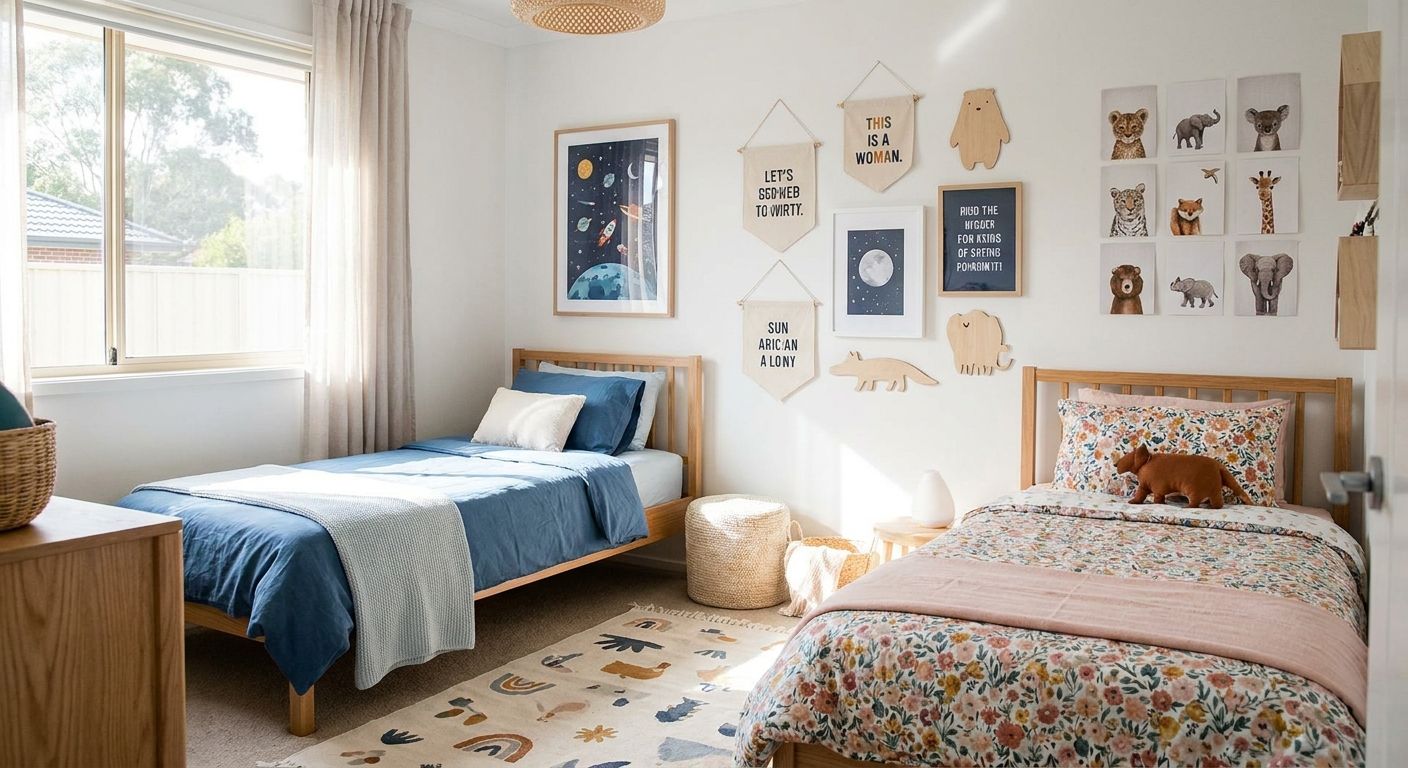
Choosing wall art for a shared kids' bedroom comes down to one rule: give each child a defined zone with their own print, then tie the two zones together with a matching frame style or color palette. Skip identical prints on both walls — siblings need visual ownership over their half of the room, not a matched set that reads like a hotel room.
The hidden cost most parents miss: shared rooms take more wall damage than solo rooms, so the hanging hardware matters as much as the print itself. Ready-to-hang canvas with reinforced backing holds up better than framed glass when there are two kids climbing on furniture underneath it.
- Give each child their own print and zone rather than matching art on both walls in 2026.
- Hang kids' wall art at 48 to 52 inches center height, lower than the adult standard of 57 to 60 inches.
- Use a shared color palette or frame style so individual prints still look cohesive.
- Ready-to-hang canvas holds up to shared-room wear better than framed glass pieces.
- Pick themes that can shift as the kids age instead of a nursery motif that gets outgrown fast.
Why this matters
A shared bedroom has two owners with two sets of preferences, and the wall art is usually the first place that tension shows up. Get the split wrong and you end up with one kid resenting the other's dinosaur poster taking over the whole room.
Get it right and the room reads as one cohesive space that still lets each kid feel like the space is theirs. That balance — individual identity, shared cohesion — is the whole job here in 2026, whether the kids are two toddlers in twin beds or a toddler and a tween sharing a room out of necessity.
How to choose wall art for a shared kids' bedroom
Work through these steps in order rather than shopping print-by-print — it keeps the room from turning into a scrapbook of unrelated pieces.
- Split the wall visually first. Identify each child's bed zone and treat the wall space above and around it as a separate canvas, even if it's the same physical wall.
- Pick one shared constraint. Choose either a single color palette, a single frame finish, or a single print size that both kids' pieces will follow — never all three, or the room feels rigid instead of playful.
- Let each kid choose within that constraint. A dinosaur print and a floral print can sit six feet apart on the same wall and still look intentional if both are framed in the same black wood and sized the same.
- Hang low. Center kids' wall art at 48 to 52 inches from the floor, not the 57 to 60 inch standard used for adult living rooms — kids actually look at what's on their own wall.
- Size to the bed, not the wall. Each print or set should run roughly two-thirds the width of the headboard or bed frame below it.
- Choose ready-to-hang canvas over framed glass for anything within reach of a bunk bed ladder or a kid standing on a mattress.
Same-age siblings sharing a room
Twins or close-in-age siblings usually want near-identical treatment, and that's fine here — a matching frame style with two different subjects (one animal print each, say) reads as coordinated rather than boring. This is the one scenario where near-symmetry actually works in a shared kids' room.
Different-age siblings sharing a room
A toddler and an older sibling need separate visual languages entirely. Keep the younger kid's zone simpler and lower, and let the older kid's side carry more detail or a bolder palette — the shared thread should be frame color or a repeated shape, not subject matter.
Bunk beds vs. twin beds
Bunk beds change the math because the top bunk changes what's within reach and what's visible from a standing height. Skip anything near the top bunk rail entirely, and put the main statement pieces on the wall opposite the bunk where both kids can see them from bed.
Why the right pick varies room to room
A handful of factors decide what actually works in any given shared bedroom, and none of them are optional to consider:
- Age gap between the kids — a two-year gap needs less separation than a six-year gap
- Bed layout — twin beds side by side split differently than a bunk bed against one wall
- Wall space available — a long wall splits easily; a short wall forces compromise
- How often taste changes — younger kids outgrow themes faster, so lower-cost, easy-to-swap prints make more sense on that side
- Gender-neutral vs. themed preference — some families want zero gendered cues, others want each kid's personality visible
- Whether the room needs to last — a room the kids will share for years benefits from art that can shift with them rather than a fixed nursery motif
A twin nursery wall art approach works for the youngest shared-room scenario, but plan to revisit the wall once the kids move past toddler age — nursery motifs age out fast.
Should each child have their own wall art?
Yes — each child in a shared bedroom should have their own print or set, not a matching piece split down the middle of the room. Shared art tends to read as one kid's taste imposed on the other, which is exactly the friction point parents are usually trying to avoid.
What size wall art works above bunk beds?
A print sized to roughly two-thirds the width of the bunk frame works best above the bottom bunk, kept well clear of the top bunk's guardrail. Avoid glass-framed pieces near the ladder or rail entirely — canvas takes contact better than anything with a glass face.
How do I keep shared bedroom art matching but not identical?
Lock in one shared constraint — frame finish, print size, or color palette — and let the actual subject matter differ between the two kids' zones. That single shared rule is what makes two different prints look chosen together instead of thrown up at random.
When choosing the right canvas size for each zone, measure the bed frame first — sizing to the wall alone is the most common mistake in shared rooms, because it ignores how much visual space each kid's furniture actually takes up.
Once sizing is settled, the hanging method matters just as much in a room with two active kids. Hanging canvas art without damaging walls becomes more important in shared rooms than almost anywhere else in the house, since door slams and bunk bed climbing put more stress on the wall than a quiet guest room ever will.
FAQ
What's the best wall art layout for a shared kids' bedroom?
The best layout splits the wall into two clear zones, one per child, each hung at 48 to 52 inches and tied together by one shared frame color or palette. Avoid a single matching set spanning both beds.
Is themed wall art better than neutral wall art for a shared kids' room?
Themed art works well when both kids are close in age and can agree on a subject; neutral, easy-to-swap prints work better with a wide age gap since they don't need replacing as fast. Pick based on how often the kids' interests are likely to shift over the next year or two.
How much wall space do I need to split for two kids?
Plan for each child's art to run about two-thirds the width of their own bed frame, which usually means each zone needs at least 3 to 4 feet of dedicated wall space in a standard bedroom.
Should wall art above bunk beds be different from wall art above twin beds?
Yes — bunk bed walls need pieces kept clear of the ladder and top rail, while twin bed walls have more open space for larger prints hung at standard kids' eye level.
Can I use the same print in both kids' zones?
You can, but it usually reads as one design decision imposed on both kids rather than two personalities sharing a room. A shared frame style with two different prints achieves the same cohesion without the flattening effect.
What height should wall art hang in a kids' bedroom?
Kids' wall art should hang with its center at 48 to 52 inches from the floor, lower than the 57 to 60 inch standard used in adult rooms, so the art sits at a height kids actually look at.
How do I choose wall art that works for kids of different ages sharing a room?
Give the younger child a simpler, lower-hung piece and let the older child's zone carry more detail or a bolder palette, with a shared frame finish as the only common thread between them.
One last thing
The single detail that trips up most parents planning a shared kids' room isn't the print choice — it's forgetting that the room needs to survive two kids' worth of activity, not one. Ready-to-hang canvas with a reinforced back outlasts anything glass-framed in a room with bunk beds or a shared toy chest underneath it, and that durability matters more in 2026 than it did when the room only had one occupant.