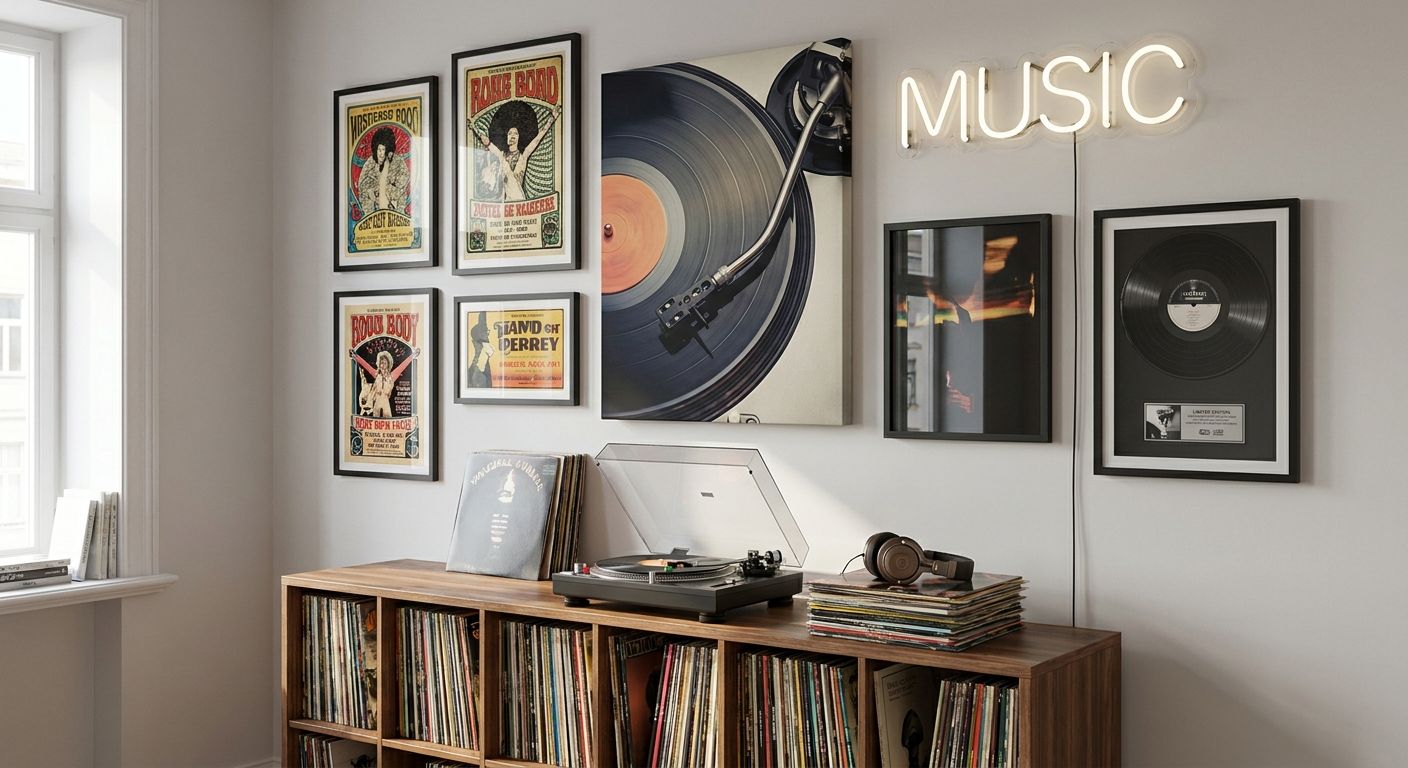
Wall art for music lovers is decor built around the visual language of sound — album-style color blocking, instrument line art, and black-and-white performance shots — with the goal of turning a listening space into a room that looks as intentional as the record collection sitting in it. Vinyl collectors have a narrower brief than the average music fan: the art has to share wall real estate with shelving, turntable furniture, and crate storage without competing for attention or blocking future crate expansion.
- Wall art for music lovers works best as a curated gallery wall mixing album-style color, line art, and black-and-white portraits.
- Vinyl collectors should size prints around shelving and turntable furniture, not the other way around.
- Canvas prints read as intentional decor in 2026 living rooms; neon bar signs read as dorm leftovers.
- A single statement piece plus 3-5 smaller framed prints outperforms one oversized print in most listening rooms.
Why wall art matters for music lovers and vinyl collectors
A record collection already does visual work — spines, sleeve colors, the ritual of pulling a record and setting it on the platter. The wall art in that room either supports that ritual or fights it. Collectors searching for wall art for music lovers are usually furnishing one of three spaces: a dedicated listening corner in the living room, a finished basement or man cave built around the turntable, or a home bar where the record player sits next to the bottles.
Each of those rooms has a different ceiling height, a different amount of shelf-adjacent wall space, and a different mood — moody and dim for a basement listening room, brighter and social for a home bar. If you're furnishing a dedicated listening space, man cave wall art picks lean toward darker palettes and bolder line work, which tends to hold up better against low, warm lighting than pastel prints do.
Define the room before you pick the print
Start with function, not aesthetics. A listening corner in an open living room needs art that reads well from a couch ten feet away; a basement man cave with a dedicated turntable stand can handle smaller, denser groupings because people stand closer to the wall while flipping records.
- Measure the wall segment that's actually free once shelving, speakers, and the turntable stand are placed
- Note the room's light source — north-facing basements need higher-contrast prints than sunlit living rooms
- Decide if the art needs to work in one glance (statement piece) or reward a closer look (gallery wall)
- Check ceiling height — anything under 8 feet favors landscape-orientation canvas over tall portrait pieces
Anchor the room with one statement piece
Every music room benefits from a single piece that does the heavy lifting — usually a large canvas print in a bold color or a striking black-and-white composition, hung on the wall with the clearest sightline from the seating area.
- Go 24x36 inches or larger for a wall over a record cabinet or console
- Pick one dominant palette that echoes a color already in the room — a red accent wall, a walnut shelving unit
- Avoid busy, multi-subject prints for this role; the statement piece should read in under three seconds
- Center it on the widest clear wall segment, not necessarily the largest wall overall
Build a gallery wall that echoes album art
Gallery walls are the natural fit for music-themed rooms because record sleeves already train the eye to expect a grid of squares and rectangles. A mixed set of framed prints in complementary tones does what a single poster can't: it fills wall space the way a crate of records fills a shelf, in pieces.
- Use an odd number of frames — five or seven reads more intentional than four or six
- Keep frame finishes consistent (all black, all natural wood) even if the print sizes vary
- Leave 2-3 inches between frames for a tight, gallery-style grid
- Mix one photographic print with two or three graphic or line-art pieces to avoid visual monotony
- Reference canvas art sets for gallery walls when you want pre-matched sizing instead of measuring each frame separately
Choose a motif that reads "music" without needing licensed band art
Most music lovers can't legally hang official tour posters at scale, and reproduction band art dates a room fast. Line art and black-and-white photography solve this — a guitar silhouette, a stack of vinyl rendered in ink lines, or a moody performance shot all signal "music room" without pinning the decor to one artist or era.
- Line art of instruments (guitar, saxophone, turntable) works in almost any color scheme
- Black-and-white photography of concert crowds or close-up instrument shots adds texture without clashing colors
- Abstract prints in a single bold hue (deep red, mustard, navy) evoke a record sleeve mood without literal imagery
- Typography prints of song lyrics or album titles work as a smaller accent, not a statement piece
Size the art around shelving and turntable furniture, not the other way around
This is the step most guides skip and the one vinyl collectors actually need. Record crates, shelving units, and turntable consoles are fixed furniture; the art has to fit what's left, not dictate a furniture rearrange.
- Measure the exact wall segment above or beside the shelving unit before ordering anything
- Leave at least 6-8 inches of breathing room between the top of furniture and the bottom of the frame
- For narrow wall strips beside a shelving unit, go portrait-orientation rather than forcing a landscape piece
- If the shelving unit is low and wide, a horizontal triptych mirrors its proportions better than one square print
Hang it without damaging rental or finished basement walls
Basements and man caves are often finished drywall over a rental lease or a wall you don't want to patch later. Canvas prints are lighter than framed glass pieces, which matters when you're choosing hanging hardware for a wall you can't drill freely into.
- Use adhesive strips rated for canvas weight on rental or finished basement walls
- Save wall anchors and screws for anything over 5 pounds or wider than 24 inches
- Check the full method in how to hang canvas art without damaging walls before committing to a rental basement setup
- Test placement with painter's tape outlines before committing to any adhesive or hardware
Comparison: which format actually fits a music room
| Format | Best for | Key limitation |
|---|---|---|
| Canvas print | Statement pieces above shelving or consoles | Can look flat without a frame in a very formal room |
| Framed art print | Gallery walls mixing sizes and finishes | Glass reflects overhead lighting in basements with limited natural light |
| Line art print | Instrument and turntable motifs in any color scheme | Reads too minimal as a lone piece over 30 inches wide |
| Original painting | A one-of-a-kind anchor piece for a serious collector's room | Higher commitment, less flexible if the room's palette changes |
The gallery wall wins for most vinyl rooms in 2026 because it scales with the collection — add a frame when you add a shelf, instead of replacing one oversized print when the room changes.
Common mistakes music lovers make with wall art
- Hanging art too high above shelving units. Vinyl collectors tend to measure for the wall, not for where the eye actually lands once a turntable console is in place — leave the 6-8 inch gap and re-measure after furniture is set.
- Choosing neon or bar-sign style pieces as the main statement. They photograph well but read as temporary decor next to a real record collection; a canvas print in a bold single color holds up longer.
- Ignoring the shelf color when picking a print palette. Walnut and black shelving units clash with pastel prints far more than with high-contrast black-and-white or jewel-toned pieces.
- Buying one oversized poster instead of a gallery set. A single 40-inch poster leaves no room to grow the display as the collection expands; a gallery wall does.
- Skipping wall-safe hanging methods in rental basements. Damage deposits disappear fast when heavy frames go up on drywall anchors that weren't necessary for a lightweight canvas.
FAQ
What's the best wall art for a vinyl listening room?
A gallery wall mixing one black-and-white photographic print with two or three line-art or abstract pieces works best for a vinyl listening room in 2026. It scales as the collection grows, unlike a single oversized poster.
Is canvas or framed art better for a music room?
Canvas prints work better for statement pieces above shelving because they're lighter and glare-free under basement lighting. Framed prints suit gallery walls where mixed sizes and finishes need a consistent border.
How do I size wall art around a turntable stand?
Measure the exact clear wall segment left after the turntable stand and shelving are placed, then leave 6-8 inches between the top of the furniture and the bottom of the frame. Portrait orientation fits narrow strips better than landscape.
Can I hang canvas art in a rented basement without damage?
Yes, adhesive strips rated for canvas weight work on most finished rental walls without leaving holes. Save wall anchors and screws for pieces over 5 pounds or wider than 24 inches.
What colors work best for a man cave listening room?
Deeper, saturated tones like navy, deep red, and mustard hold up better than pastels under the warm, low lighting typical of a man cave. Match the print's dominant color to one accent already in the room, like a shelving unit or accent wall.
Should I hang licensed band posters or original art?
Original line art or abstract prints age better than licensed band posters, which tie the room to one artist or era. A guitar silhouette or turntable line drawing reads as music decor without dating the room.
How many pieces should be in a music-themed gallery wall?
Five to seven framed pieces in an odd number reads more intentional than an even count. Keep frame finishes consistent even when print sizes vary.
What's the difference between a statement piece and a gallery wall for music rooms?
A statement piece is one large canvas that reads in under three seconds from across the room, best for a single clear wall. A gallery wall is a grouped set that rewards a closer look and grows with the collection over time.
One last thing
The detail most vinyl collectors miss: hang the gallery wall at record-crate height, not standard eye-level height, if the wall sits directly beside the shelving unit — it keeps the sightline continuous from crate to print instead of splitting the wall into two disconnected zones. Test that alignment with painter's tape before any adhesive goes up.