Eclectic wall art pulls together clashing colors, mismatched frames, and unrelated subjects on purpose — and in a maximalist room, that mix is the whole point.
- Eclectic wall art works in maximalist rooms when you mix at least 3 subject types across one wall.
- Shadow of the Geisha anchors a moody gallery wall at $179.99 — Buy.
- Skip matched art sets in a maximalist room; they flatten the layered look you're going for.
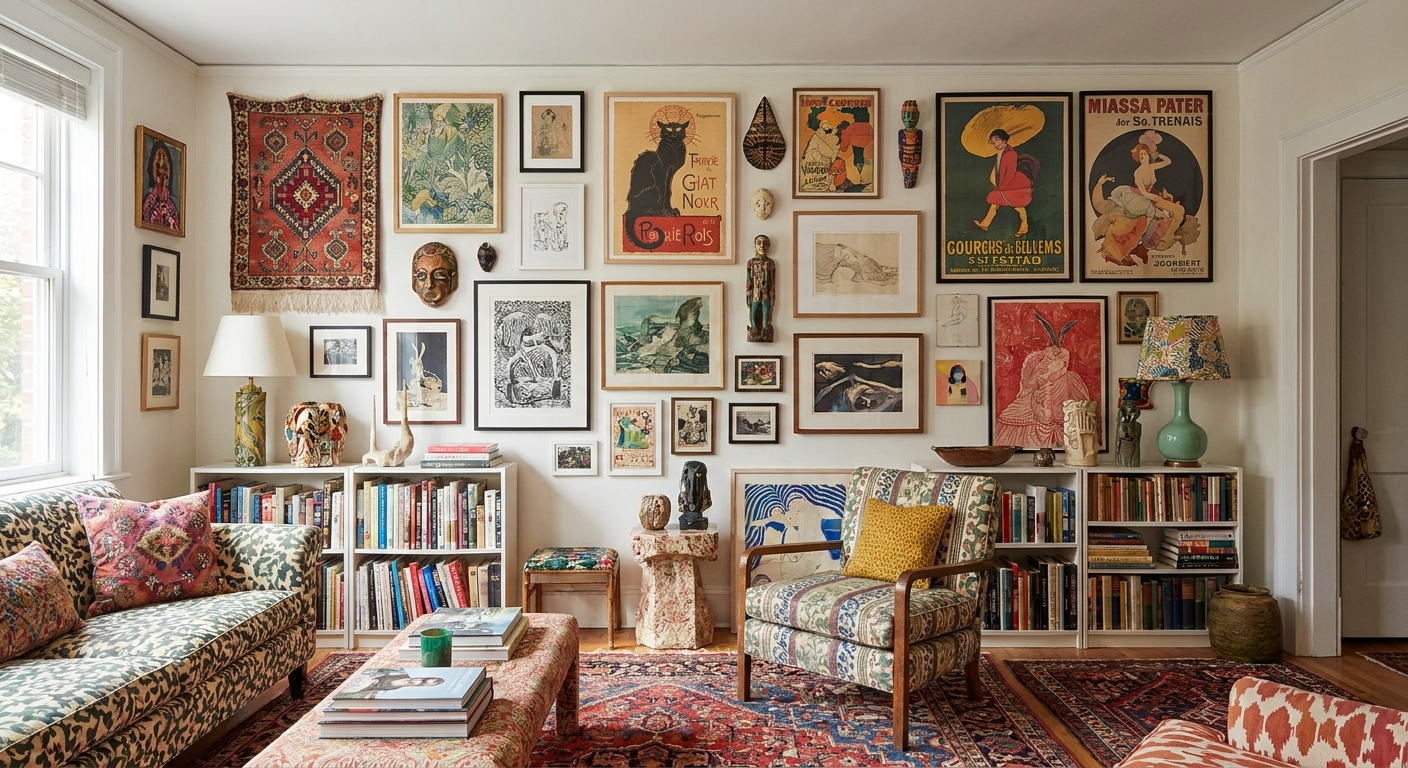
- A gallery wall of 5-7 mismatched frames reads as curated, not cluttered, once palette ties it together.
Why this matters
Maximalist decorating gets a bad reputation for looking chaotic, and the wall is usually where that reputation gets earned or lost. A room can carry patterned rugs, layered textiles, and bold paint and still feel intentional — but only if the art on the wall has a logic to it, even a loose one.
The mistake most people make with eclectic wall art is treating "eclectic" as an excuse to buy whatever catches their eye with zero plan. That's how you end up with a wall that reads as cluttered instead of curated. The fix isn't more restraint — it's a thread. One color, one mood, or one recurring shape that shows up across every piece, even when the subjects have nothing in common.
Who this is for
This guide is for the shopper who already owns a patterned sofa, a gallery of textures, and zero interest in a single matching art set. You like color. You collect. You want a wall that looks like it happened over years, not one Saturday afternoon at a big-box store. If your living room already leans maximalist — layered rugs, brass accents, more than one bold print in the upholstery — this is your art strategy.
What to look for in eclectic wall art for maximalist rooms
Color that clashes on purpose
A maximalist wall needs contrast, not coordination. Look for pieces where the palette pulls from different families — a warm ochre next to a cool indigo, a black-and-white photograph next to a saturated floral. If every piece on your shortlist uses the same three muted tones, you're building a minimalist wall by accident.
A mix of subject matter, not just one theme
One wall, three different subjects: a portrait, a landscape, an abstract pattern. That variety is what separates eclectic from "themed." A wall of five botanical prints in different sizes is still a themed wall — it just has more pieces on it. True eclectic mixing means the subjects don't obviously belong together until the palette or scale ties them.
Frame finishes that don't match
A black frame next to a natural wood frame next to a canvas with no frame at all — this is where the eclectic look actually lives. Matching frames across a maximalist wall reads as an art set, which undercuts the whole point. Mixed finishes signal that each piece was chosen on its own merits, not bought as a bundle.
Scale big enough to compete with the room
Maximalist rooms are busy — patterned wallpaper, layered lighting, textured furniture. Small art gets swallowed. At least one piece on the wall should be large enough to anchor the eye before it wanders to the rest of the room; for most living rooms that means a canvas in the 30x40 inch range or larger as your anchor point, with smaller pieces built around it.
One thread that ties it all together
This is the rule that keeps eclectic from tipping into chaotic. Pick a single thread — a recurring red, a shared brushstroke style, a consistent black-and-white accent — and make sure it appears in every piece on the wall, even the mismatched ones. Matisse-inspired prints do this well for eclectic homes because the bold color-block style gives wildly different subjects a shared visual language.


Top picks for eclectic wall art in 2026
Shadow of the Geisha — the moody anchor. This is a portrait piece with heavy shadow work, priced at $179.99, and it's the kind of dark, saturated tone that grounds a busy wall instead of adding to the noise. Hang it as your largest piece and build the rest of the gallery around its contrast. Buy.
Iron Passage — the industrial contrast piece. At $179.99, this print brings texture and structure that plays against softer florals or portraits on the same wall. It's the piece that stops an eclectic wall from feeling too soft or too sweet. Buy.
Hibiscus Bird — the color jolt. Priced at $179.99, this is your saturated floral moment — the piece that injects warmth next to darker or more muted neighbors. In a maximalist room already carrying bold color elsewhere, this print pulls double duty tying the wall to the rest of the space. Buy.
Geometry, Style B — the pattern breaker. At $179.99, this abstract geometric piece is the one that keeps a wall of portraits and landscapes from feeling too literal. It's a smart addition once you already have 3-4 representational pieces committed, but it can feel out of place as a starting point. Consider.
Meditation Circles B - Portrait 2 — the calming counterweight. Also $179.99, this piece works best as the smallest item on a busy wall, giving the eye a place to rest between bolder pieces. On its own it reads too quiet for a true maximalist statement wall. Consider.
What to avoid
- Matched art sets. A set of three prints designed to hang together as a trio undoes the eclectic look before it starts — they're built for coordination, not contrast.
- A single, tight palette across every piece. If every print pulls from the same three neutrals, you've built a quiet, cohesive wall, not an eclectic one. Maximalist rooms need friction.
- Everything at the same size. A wall of five identically sized 16x20 prints looks like a grid, not a collection. Vary the sizes the way you'd vary anything else in a layered room.
How you group the pieces once you've picked them matters just as much as the picks themselves — a loose, offset gallery wall arrangement does more for the eclectic look than a perfectly symmetrical grid ever will.
Verdict comparison
| Pick | Best placement | Price | Verdict |
|---|---|---|---|
| Shadow of the Geisha | Large anchor piece | $179.99 | Buy |
| Iron Passage | Contrast/texture piece | $179.99 | Buy |
| Hibiscus Bird | Color accent | $179.99 | Buy |
| Geometry, Style B | Pattern breaker (add later) | $179.99 | Consider |
| Meditation Circles B - Portrait 2 | Small quiet accent | $179.99 | Consider |
“Eclectic only works when one thread runs through every piece — the wall isn't random, it just looks that way.”
FAQ
What is eclectic wall art?
Eclectic wall art mixes different subjects, colors, and frame styles on one wall instead of matching a single theme. In 2026 the look is common in maximalist and boho-leaning interiors that already layer pattern and texture elsewhere in the room.
How many pieces should be on an eclectic gallery wall?
Most eclectic gallery walls work best with 5-7 pieces of varied size. Fewer than 5 tends to look sparse for a maximalist room, and beyond 9 or so the wall needs a stronger unifying color or frame thread to avoid feeling messy.
Is eclectic wall art the same as boho wall art?
They overlap but aren't identical. Boho leans on natural textures and warm earth tones, while eclectic is broader and can include bold color, geometric prints, and portraiture side by side, as long as one visual thread ties the pieces together.
Should eclectic wall art frames match?
No, mismatched frame finishes are part of the look. A black frame, a natural wood frame, and an unframed canvas on the same wall reads as collected over time rather than bought as a set.
What size should the largest piece be on an eclectic wall?
Aim for at least 30x40 inches for your anchor piece in a standard living room. Anything smaller risks getting lost against a maximalist room's existing pattern and texture.
Can eclectic wall art work in a small apartment?
Yes, but scale down the anchor piece and cap the gallery at 4-5 prints so the wall doesn't overwhelm a smaller room. The same rules on frame variety and a unifying color thread still apply.
How much does eclectic wall art cost?
Canvas prints for an eclectic gallery wall typically run in the $150-$220 range per piece in 2026, so a 5-piece wall lands roughly between $750 and $1,100 depending on size and finish.
One last thing
Odd numbers read better on a wall than even ones — a group of 5 or 7 pieces settles into a room more naturally than 4 or 6, because the eye can't split it into a neat, symmetrical pair. If your eclectic wall feels slightly off no matter how you arrange it, count your pieces before you touch the layout again.